India’s transportation ecosystem is entering a new phase — one where roads, railways, ports, GPS, FASTag and logistics data could increasingly work together.
On 6 October 2026, the Union Cabinet approved the establishment of the Integrated Transport & Logistics Authority (ITLA), a new apex institution intended to strengthen coordination, planning, research, project appraisal, monitoring and impact assessment across India’s transportation and logistics sectors. (PIB)
At first glance, this may sound like another government-level infrastructure reform.
But for India’s truck owners, fleet operators, transport companies and logistics businesses, there is a much bigger story behind it.
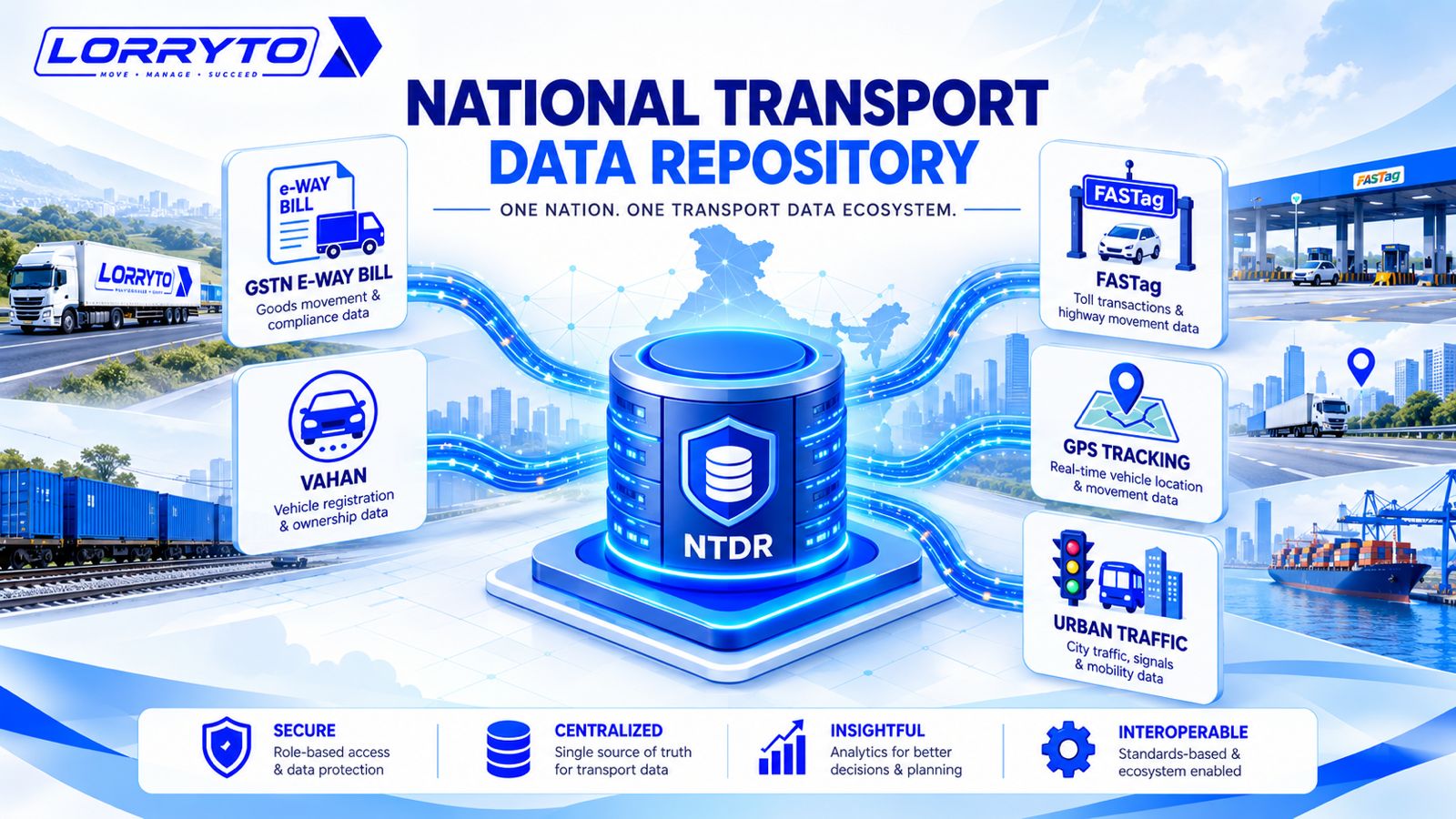
One of the most important responsibilities proposed for ITLA is the development of a National Transport Data Repository (NTDR) — a unified transport data repository that will integrate information from sources such as GSTN e-way bills, FASTag, VAHAN, GPS-based systems and urban traffic management systems. (PIB)
That could have a major long-term impact on how India plans freight movement, builds infrastructure and uses transportation data.
For transport businesses, it also sends a clear message:
The future of Indian transportation is becoming increasingly data-driven.
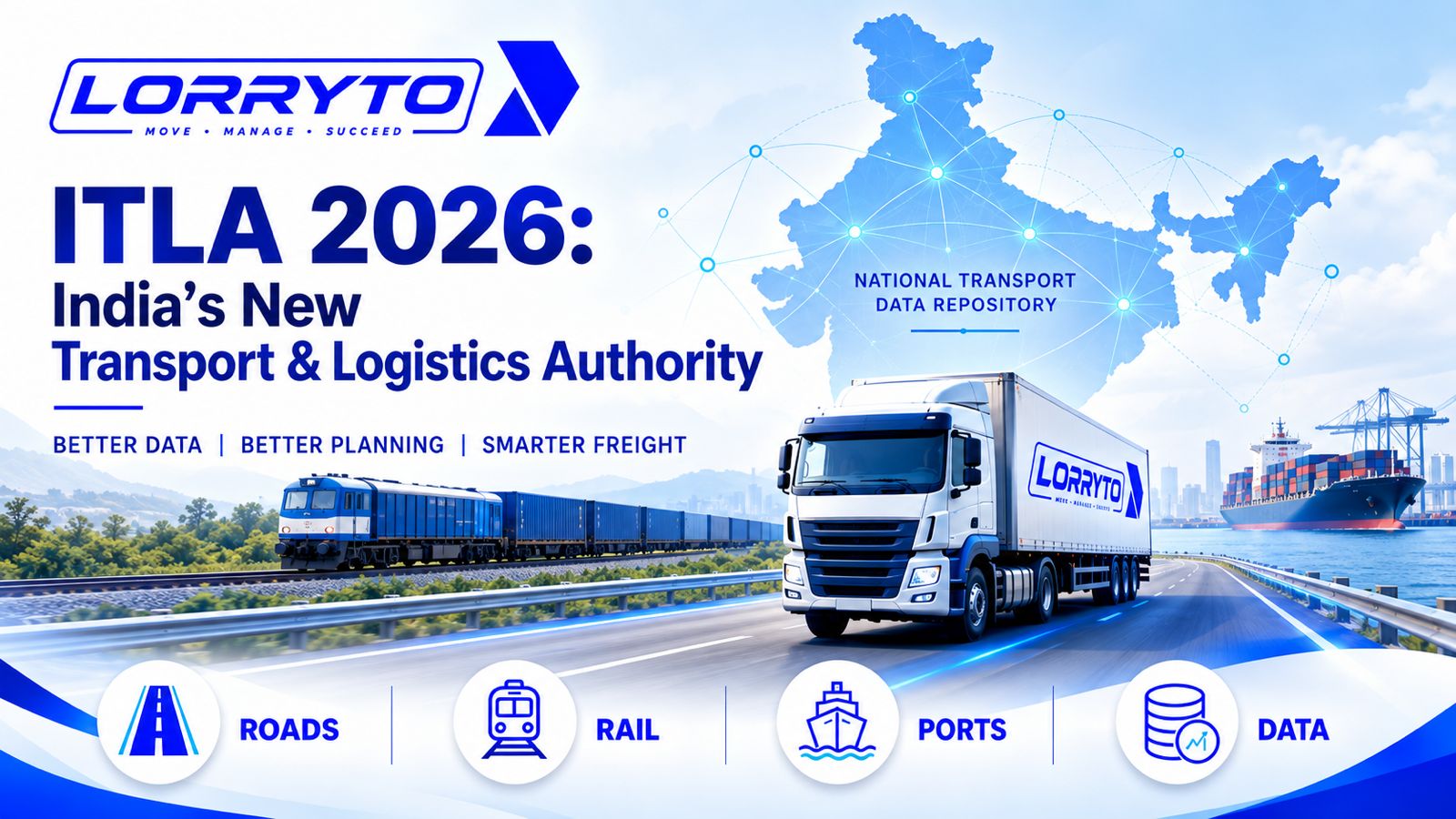
What is the new Integrated Transport & Logistics Authority?
The Integrated Transport & Logistics Authority, or ITLA, is being established under the Ministry of Commerce & Industry as an apex body for integrated transport and logistics planning.
Its objective is to improve coordination between different transportation sectors instead of planning each mode in isolation.
These sectors include:
- Roads and highways
- Railways
- Ports and shipping
- Civil aviation
- Inland waterways
- Coastal shipping
- Urban mobility
- Logistics
According to the Government of India, ITLA will work on integrated planning, research, project appraisal, monitoring, data analytics, logistics policy support, capacity building and innovation. (PIB; The Hindu)
The authority is also expected to prepare a long-term National Transport Master Plan with a planning horizon of 10 years or more.
This is important because India’s freight ecosystem does not operate through one transportation mode.
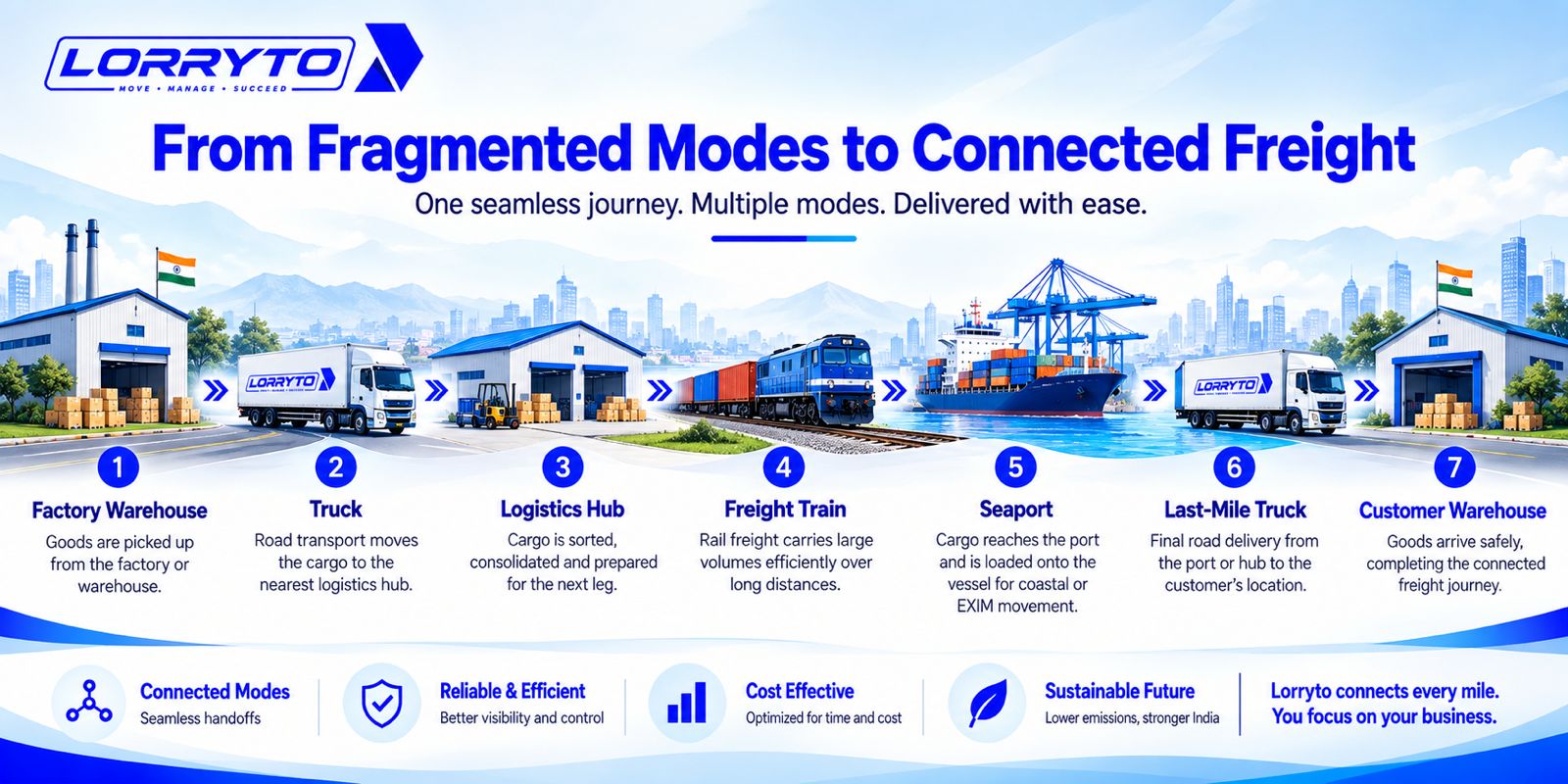
A shipment may start on a truck, move through a logistics hub, connect to rail, reach a port and eventually travel again by road — the same multimodal shift we covered in how Dedicated Freight Corridors are changing road transport and the BRICS transport agenda.
When each part of that journey is planned separately, inefficiencies can appear.
ITLA is intended to help bring these different pieces into a more coordinated framework.
Why does India need an integrated transport authority?
India’s logistics network has expanded rapidly over the last decade.
New highways are being built. Railway freight capacity is expanding. Ports are being modernised. Dedicated Freight Corridors are changing long-distance freight movement. Warehousing and logistics parks are developing around major economic corridors.
At the same time, transportation has become increasingly digital.
Today, a single freight movement can generate information through:
E-way bills → FASTag → vehicle registration → GPS → toll transactions → logistics systems → delivery documents
The challenge is that these systems have historically operated across different platforms, departments and databases.
The government’s latest move is aimed at improving coordination between these systems at the infrastructure and policy level.
The broader objective is straightforward:
Better data → better planning → better infrastructure → more efficient freight movement.
The Government of India’s own background material points to the country’s broader shift toward integrated infrastructure planning and digital logistics systems, including PM GatiShakti, the Unified Logistics Interface Platform (ULIP), the Logistics Data Bank and FASTag — the same digital stack we explored in how technology is changing the way India moves goods. (PIB — Infrastructure at the Core of India’s Growth)
The biggest development: National Transport Data Repository
For the transportation industry, one of the most interesting parts of the ITLA announcement is the proposed National Transport Data Repository (NTDR).
According to the official government release, ITLA will develop a unified transport data repository by integrating relevant datasets from multiple sources.
These include:
- GSTN e-way bills
- FASTag
- VAHAN
- GPS-based systems
- Urban traffic management systems
- Other relevant transport and logistics databases (PIB)
The authority is expected to use this information for freight-flow analysis and origin-destination (O-D) analytics, along with planning, monitoring and impact assessment.
In simple terms, India wants to understand transportation not only through individual roads or projects, but through actual movement patterns across the country.
That is a major shift.
What does this mean in simple terms?
Imagine thousands of trucks moving between different cities every day.
Each truck generates different types of information.
For example:
FASTag — shows toll transactions and movement through toll locations.
GPS — can provide information about vehicle location and movement.
VAHAN — contains vehicle-related information.
E-way bills — provide information associated with movement of goods under the GST framework.
Urban traffic systems — can provide information about traffic movement and congestion.
Individually, each dataset provides only part of the picture.
But when transportation data is analysed together, a much larger picture can emerge.
For example:
Which freight corridors are becoming congested?
Which routes are experiencing increasing freight demand?
Where are new logistics facilities needed?
Which regions need better road or rail connectivity?
Where are bottlenecks affecting freight movement?
How are goods actually moving between origin and destination?
This is where data can become a powerful planning tool.
From building roads to understanding how roads are used
Infrastructure planning traditionally involves questions such as:
Where should a highway be built?
Where should a railway line be expanded?
Where should a logistics hub be developed?
With more integrated transportation data, another question becomes increasingly important:
How are people and goods actually moving through the existing network?
That distinction matters.
Building infrastructure without understanding actual demand can create inefficiencies.
But analysing real transportation patterns can help policymakers identify where capacity is genuinely required.
The government’s stated objective for ITLA is to use integrated planning and data analytics to improve infrastructure efficiency, multimodal connectivity and logistics competitiveness. (PIB; Indian Express)
What could this mean for truckers?
The immediate impact on a truck owner should not be exaggerated.
ITLA does not mean that every truck operator will suddenly experience a major change in day-to-day operations.
The authority is primarily a planning, coordination, research, appraisal and monitoring institution.
However, the direction it represents is important.
The transportation industry is moving toward an environment where digital data is becoming increasingly important — the same direction we covered in why digitisation is transforming Indian transport.
For a truck owner or fleet operator, that means the ability to accurately record and understand operations could become more valuable over time.
Consider a typical transport business.
A truck completes a trip.
During that trip, the business may deal with:
- Driver information
- Vehicle information
- LR details
- E-way bill
- Fuel expenses
- Toll expenses
- Maintenance expenses
- Advance payments
- Loading and unloading
- GPS location
- POD
- Customer invoice
- Outstanding payment
- Driver settlement
If this information is scattered across notebooks, WhatsApp messages, spreadsheets and different applications, it becomes difficult to understand the actual performance of the business.
But if the information is digitally organised — through workflows like creating an LR, recording trip expenses, uploading POD and raising invoices — it becomes possible to answer much better questions.
Vehicle tracking is only one part of the story
GPS tracking has already become an important part of modern fleet management.
But there is an important distinction between knowing where a truck is and understanding what is happening with that truck’s business operation.
A GPS system can tell you:
“Truck MH-XX-XXXX is currently here.”
A transport management system can help answer:
Which trip is this vehicle on?
Which driver is operating it?
Which customer does the trip belong to?
What is the LR number?
What expenses have been recorded?
Has the POD been uploaded?
Has the customer been invoiced?
How much payment is outstanding?
Was the trip profitable?
That is where transportation technology becomes much more valuable — as we explored in digital trip tracking and trip profit management.
The future is not just vehicle tracking — it is connected transport data
The direction of the Indian logistics ecosystem suggests that transportation data will increasingly become interconnected.
Government systems are becoming digital.
Freight documentation is becoming digital.
Toll collection is digital.
Vehicle information is digital.
GPS systems generate location data.
Logistics platforms generate operational data.
Transport businesses themselves generate enormous amounts of information every day.
The opportunity is to turn all of this information into useful decisions.
For a transporter, that could mean moving from:
“Where is my truck?”
to:
“How efficiently is my truck operating?”
And eventually:
“How profitable is my entire fleet?”
FASTag is becoming more than a toll-payment system
FASTag is already deeply integrated into India’s highway ecosystem.
The government has highlighted FASTag as one of the digital systems supporting cargo visibility, information sharing and logistics efficiency. (PIB)
According to government data, more than 98% of highway toll collection was taking place through FASTag-based electronic transactions as of December 2025. (PIB)
This shows how extensively digital tolling has become part of India’s transportation infrastructure — a theme we also covered in FASTag OneTag portability for truckers.
But the significance of FASTag goes beyond simply paying tolls.
When combined with other datasets, transport-related digital information can help provide a broader understanding of movement across the network.
This is exactly why FASTag is one of the data sources specifically mentioned in the proposed National Transport Data Repository.
E-way bills and transport data
The same principle applies to GSTN e-way bills.
The e-way bill system already creates a digital trail associated with the movement of goods.
When information from e-way bills is analysed alongside other transportation datasets, policymakers can potentially develop a better understanding of freight flows.
The important point is that ITLA’s NTDR is not simply about collecting more data.
The real objective is to use integrated data for:
- Freight-flow analysis
- Origin-destination analysis
- Infrastructure planning
- Project monitoring
- Impact assessment
- Transport policy decisions (PIB)
The value comes from connecting information and turning it into useful analysis.
What does this mean for fleet owners?
For fleet owners, the direction of the industry is particularly important.
Imagine two transport companies.
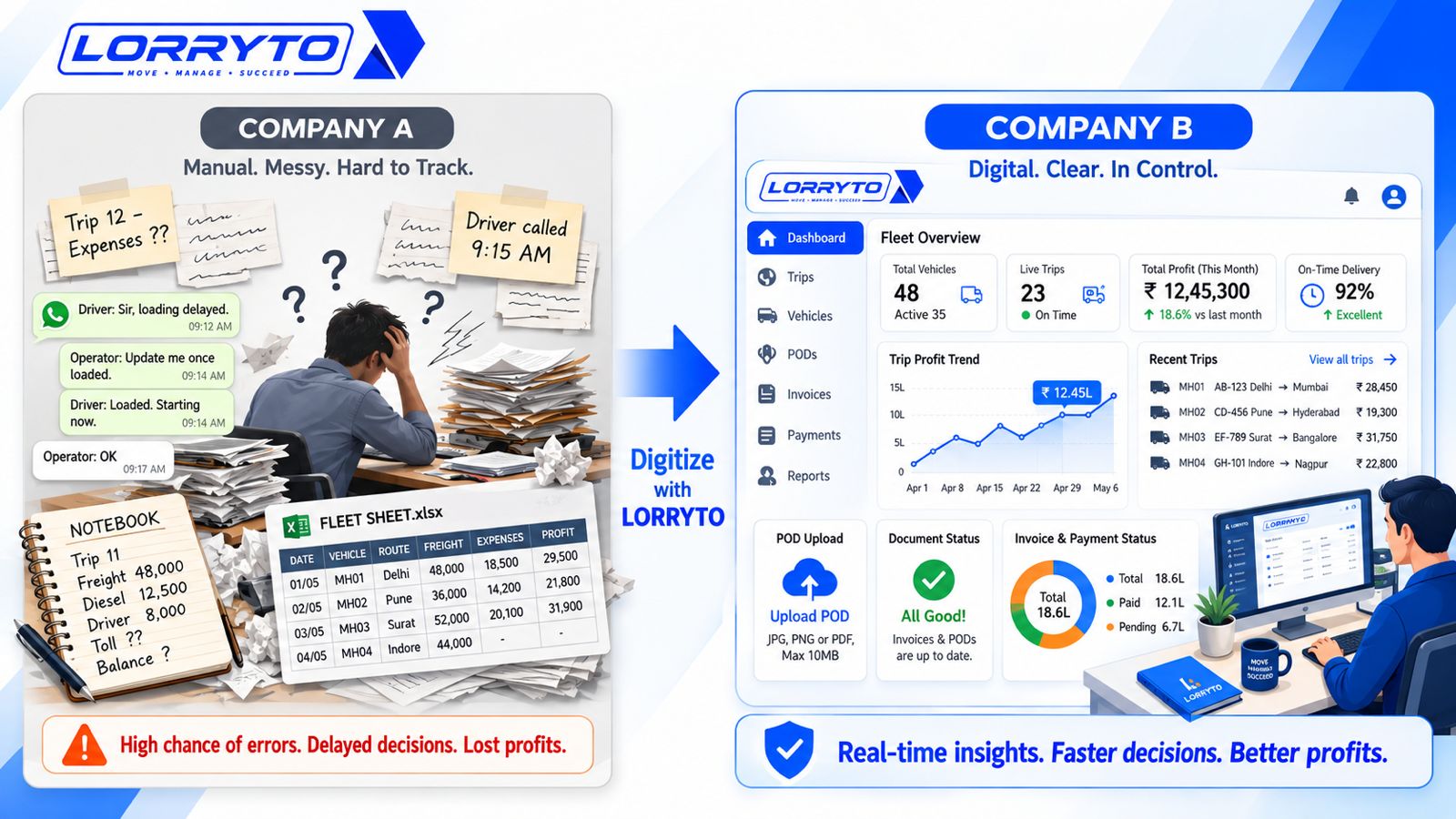
Transport Company A
It has 50 trucks but keeps most information in:
- Excel
- Paper documents
- Separate GPS software
- Manual expense registers
The owner knows that the business is operating, but getting a complete picture requires significant manual effort.
Transport Company B
The company maintains structured digital information for:
- Vehicles
- Drivers
- Trips
- LRs
- Documents
- Expenses
- GPS
- PODs
- Invoices
- Payments
- Profitability
Now the owner can ask:
Which vehicles are most profitable?
Which routes generate the highest expenses?
Which drivers have pending documentation?
Which customers have outstanding payments?
Which trips are losing money?
Which vehicles are underutilised?
The second company is not necessarily operating more trucks.
It is simply operating with better information.
And that difference can become increasingly important as transportation becomes more data-driven.
Why transport businesses should start digitising now
The creation of ITLA is not a reason for transporters to panic or immediately change their entire technology stack.
Instead, it is another signal of a larger industry trend.
Indian logistics is moving toward:
Digital records → Connected systems → Real-time visibility → Data analytics → Data-driven decisions
Transporters who still depend entirely on manual processes may eventually find it harder to manage growing fleets efficiently.
Digitisation does not necessarily mean buying complicated enterprise software.
It can start with simple operational discipline:
- Maintain digital trip records
- Keep vehicle data updated
- Record expenses against trips
- Track vehicle documents
- Maintain driver information
- Upload PODs digitally
- Monitor outstanding payments
- Track vehicle movement
- Calculate trip profitability
The important thing is to create structured and reliable operational data.
Will ITLA immediately change the way trucks operate?
No — and this distinction is important.
ITLA has just been approved.
Its role is primarily focused on integrated planning, research, project appraisal, monitoring, data analytics, logistics policy support and related institutional functions.
The government has announced the framework and responsibilities, but that does not mean every transporter will immediately experience operational changes. (Economic Times)
The National Transport Data Repository is also a development that will evolve.
Therefore, transport businesses should look at ITLA as a long-term direction for India’s transportation ecosystem, rather than expecting an overnight change.
ITLA and the future of multimodal logistics
India’s freight movement is increasingly becoming multimodal.
A shipment may travel through several modes before reaching its final destination.
For example:
Factory → Truck → Logistics Hub → Rail → Port → Ship → Port → Truck → Customer
If each mode is planned independently, bottlenecks can appear between them.
Integrated transportation planning attempts to address exactly this problem.
The government says ITLA will work across roads, railways, ports, shipping, aviation, inland waterways, coastal shipping, urban mobility and logistics, while aligning different plans with a long-term National Transport Master Plan. (PIB; Indian Express)
For India’s trucking industry, this matters because road transport will remain an important connecting layer between these different modes.
What transporters should watch next
The announcement of ITLA is only the beginning.
Transport businesses should watch how several areas develop over the coming years.
1. National Transport Data Repository
How the NTDR is implemented, what datasets are integrated and how analytics are used will be important.
2. Digital logistics platforms
Platforms that connect different logistics data sources could become increasingly important.
3. Real-time visibility
GPS and other vehicle-visibility technologies will continue to become more important for fleet operations.
4. Multimodal freight
Road, rail, ports and logistics hubs will increasingly need to operate as a connected network.
5. Data-driven infrastructure
Future infrastructure decisions may increasingly rely on actual freight-flow and transportation data.
6. Digital transport operations
Transport companies will increasingly need reliable digital records of trips, vehicles, drivers, documents, expenses and payments.
What should a transporter do today?
The good news is that transporters do not need to wait for ITLA to become operational before improving their businesses.
There are several things a transport company can start doing today.
Start with your vehicles
Maintain accurate information about every vehicle, including documents, expiry dates and operating status — see Vehicles list and vehicle documents.
Digitise trips
Keep trip information organised from booking to delivery — start with create booking and create LR.
Track expenses
Record fuel, toll, maintenance and other trip-related expenses properly — trip expenses and vehicle expenses.
Keep documents accessible
Digitise LR, POD and other important transport documents — POD and trip documents.
Monitor vehicle movement
Use GPS or other suitable tracking technology to improve visibility — covered in digital trip tracking.
Track payments
Connect invoices and outstanding payments with customers and trips — create invoice and add payment.
Measure profitability
Don’t only ask how much revenue a trip generated.
Ask:
How much profit did the trip actually generate?
This is where transport management software can make a significant difference — see trip profit management.
Where LORRYTO fits into this changing landscape
The transportation industry does not become data-driven simply because governments create large databases.
Individual transport businesses also need to organise their own operational data.
That is where a transport management platform can help.
LORRYTO is designed to bring key transport operations into one platform — including:
- LR and booking management
- Trip and load management
- Vehicle tracking (when drivers share GPS)
- Driver management
- POD and document uploads
- Invoicing
- Payment and outstanding tracking
- Vehicle and driver expenses
- Vehicle document alerts
- Profit and loss reporting
- Multi-branch operations
- WhatsApp sharing
The bigger idea is simple:
A transporter should not have to search across notebooks, spreadsheets, WhatsApp messages and different systems just to understand what is happening with a trip.
When operational data is organised in one place, it becomes easier to monitor the business and make better decisions.
And as India’s wider transportation ecosystem becomes increasingly data-driven, this type of operational visibility will become even more valuable.
If you are ready to start, getting started with Lorryto is a practical place to begin.
The bigger picture: from data collection to data intelligence
India has already spent years digitising individual parts of its logistics ecosystem.
FASTag digitised toll collection.
E-way bills digitised important aspects of goods movement compliance.
VAHAN digitised vehicle-related information.
GPS systems created real-time vehicle-location data.
ULIP is helping connect logistics-related data across government departments.
PM GatiShakti has pushed integrated infrastructure planning.
The creation of ITLA adds another layer to this evolution by creating an institutional framework for integrated transport planning and a proposed National Transport Data Repository.
The direction is clear.
India is moving from simply building transportation infrastructure toward understanding, connecting and optimising the transportation network through data.
For transporters, this creates both a challenge and an opportunity.
The challenge is that manual, fragmented operations may become increasingly difficult to scale.
The opportunity is that transport businesses with clean, connected operational data can make faster and more informed decisions.
Final takeaway
The creation of the Integrated Transport & Logistics Authority is not just another government announcement.
It represents a broader shift in how India is thinking about transportation.
Instead of looking at highways, railways, ports, waterways, airports and logistics as completely separate systems, the country is moving toward a more integrated approach.
And the proposed National Transport Data Repository could become one of the most important parts of that transition.
For India’s truckers and fleet owners, the message is simple:
The future of transportation will not be driven only by trucks, roads and infrastructure. It will increasingly be driven by the data generated by those trucks, roads and logistics networks.
Transport businesses that start organising their operational data today will be better positioned for that future.
Because the next generation of Indian transport companies may compete not only on how many trucks they operate, but also on how intelligently they operate them.
Frequently asked questions
What is the Integrated Transport & Logistics Authority (ITLA)?
ITLA is a new apex institution approved by the Union Cabinet to strengthen integrated planning, research, project appraisal, monitoring, impact assessment and coordination across India’s transport and logistics sectors. (PIB)
When was ITLA approved?
The Union Cabinet approved the establishment of ITLA on 6 October 2026. (PIB)
What is the National Transport Data Repository?
The National Transport Data Repository (NTDR) is a proposed unified transport data repository that will integrate relevant datasets from sources including GSTN e-way bills, FASTag, VAHAN, GPS-based systems and urban traffic management systems. (PIB)
Why is the National Transport Data Repository important?
The repository is intended to support freight-flow analysis, origin-destination analysis, transport planning, project monitoring and impact assessment. (PIB)
Will ITLA directly manage trucks and transport companies?
No. ITLA is primarily a planning, coordination, research, appraisal, monitoring and data-analysis institution. It is not being established as an agency to directly manage individual trucking businesses.
Will ITLA immediately change the way truckers operate?
Not necessarily. The authority represents a long-term change in India’s transport-planning ecosystem. The practical impact on individual transporters will depend on how its systems, policies and data initiatives are implemented over time.
Why should transporters care about transport data?
Accurate operational data can help transporters understand vehicle utilisation, trip costs, expenses, profitability, driver operations, documents, payments and overall fleet performance.
What should transporters do now?
Transport businesses can begin by digitising trip records, vehicle information, driver information, documents, expenses, PODs, invoices, payments and vehicle tracking. Building structured operational data today can make future technology adoption much easier — start with getting started.
Related reading
- How Technology Is Changing the Way India Moves Goods
- BRICS Transport Ministers’ Declaration 2026: What It Means for Logistics and Transport
- India’s Freight Rail Network Is Changing Road Transport: What the Dedicated Freight Corridors Mean for Truckers
- Why Digitization Is Transforming the Transport Industry in India
- How to Manage Every Trip Tracking Digitally for Indian Transporters
- How to Manage Every Trip Profit Digitally for Indian Transporters
- FASTag Is Becoming Portable Like a Mobile SIM: What OneTag Means for India’s Truckers and Fleets
- Getting started with Lorryto
- Vehicles list — location, KPIs, and fleet visibility
- Create LR · POD · Trip expenses · Create invoice
Sources & references
- Cabinet approves setting up of Integrated Transport & Logistics Authority — Press Information Bureau (6 October 2026)
- ITLA factsheet — Press Information Bureau (6 October 2026)
- Infrastructure at the Core of India’s Growth and Competitiveness — Press Information Bureau (ULIP, Logistics Data Bank, FASTag background)
- Cabinet greenlights new apex body to oversee transport and logistics — The Indian Express (6 October 2026)
- Cabinet approves new authority to integrate India’s transport, logistics planning — The Economic Times (6 October 2026)
- Cabinet approves proposal to set up Integrated Transport and Logistics Authority — The Hindu (6 October 2026)
Ready to run trips without registers?
Create LRs, track payments, and keep documents in one place with Lorryto — free trial available.
Start Free Now