The next big change in trucking may not be another tracking device or transport app. It could be software that knows what needs to be done next and helps get it done.
Consider a familiar situation at a transport office. A truck has reached its destination, but the proof of delivery has not arrived. The customer is asking for an update, the next trip is waiting to be assigned, and an earlier invoice is still unpaid. Meanwhile, someone from the office is trying to reach the driver on the phone.
None of these tasks is particularly complicated on its own. The problem is that they rarely happen one at a time.
This is where a new development in artificial intelligence, known as agentic AI, could make a difference to the trucking industry. Instead of simply displaying information or answering questions, AI agents can work towards a defined goal, use connected tools and coordinate multiple steps with varying levels of human supervision.
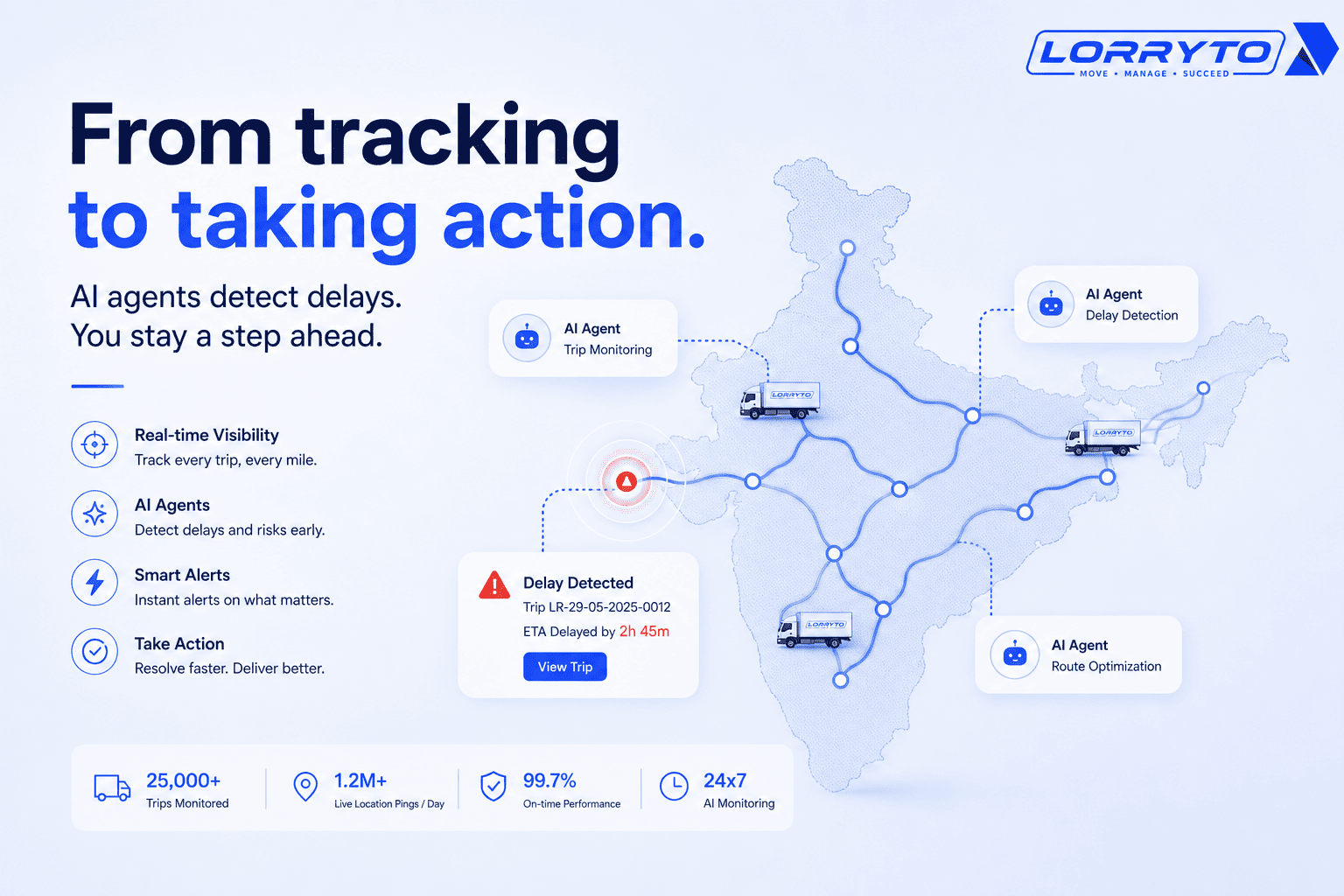
For Indian transporters, that could mean fewer repetitive follow-ups, better coordination between trips and documents, and more time to focus on customers and business decisions — building on the broader shift we covered in agentic AI from tracking to action and how technology is changing the way India moves goods.
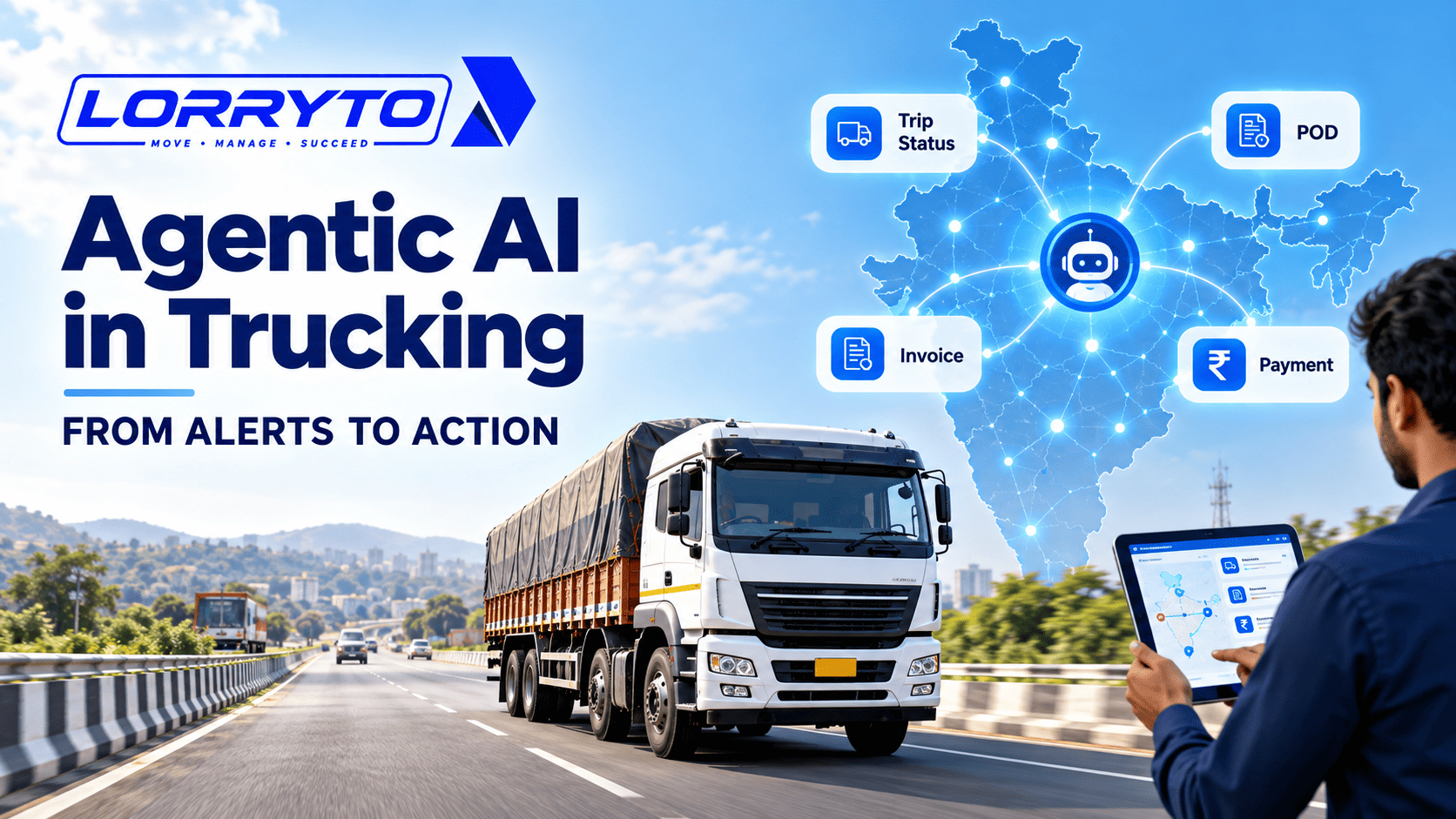
What exactly is agentic AI?
Most people are already familiar with AI chatbots. You ask a question, and the system generates an answer. Some AI tools can also summarise documents, analyse spreadsheets or suggest ways to improve a process.
Agentic AI takes the idea further.
An AI agent can receive a goal, examine relevant information, decide which steps are needed, use authorised software tools and check whether the task has been completed. Depending on how the system is designed, it may also ask a person to approve an important decision before proceeding.
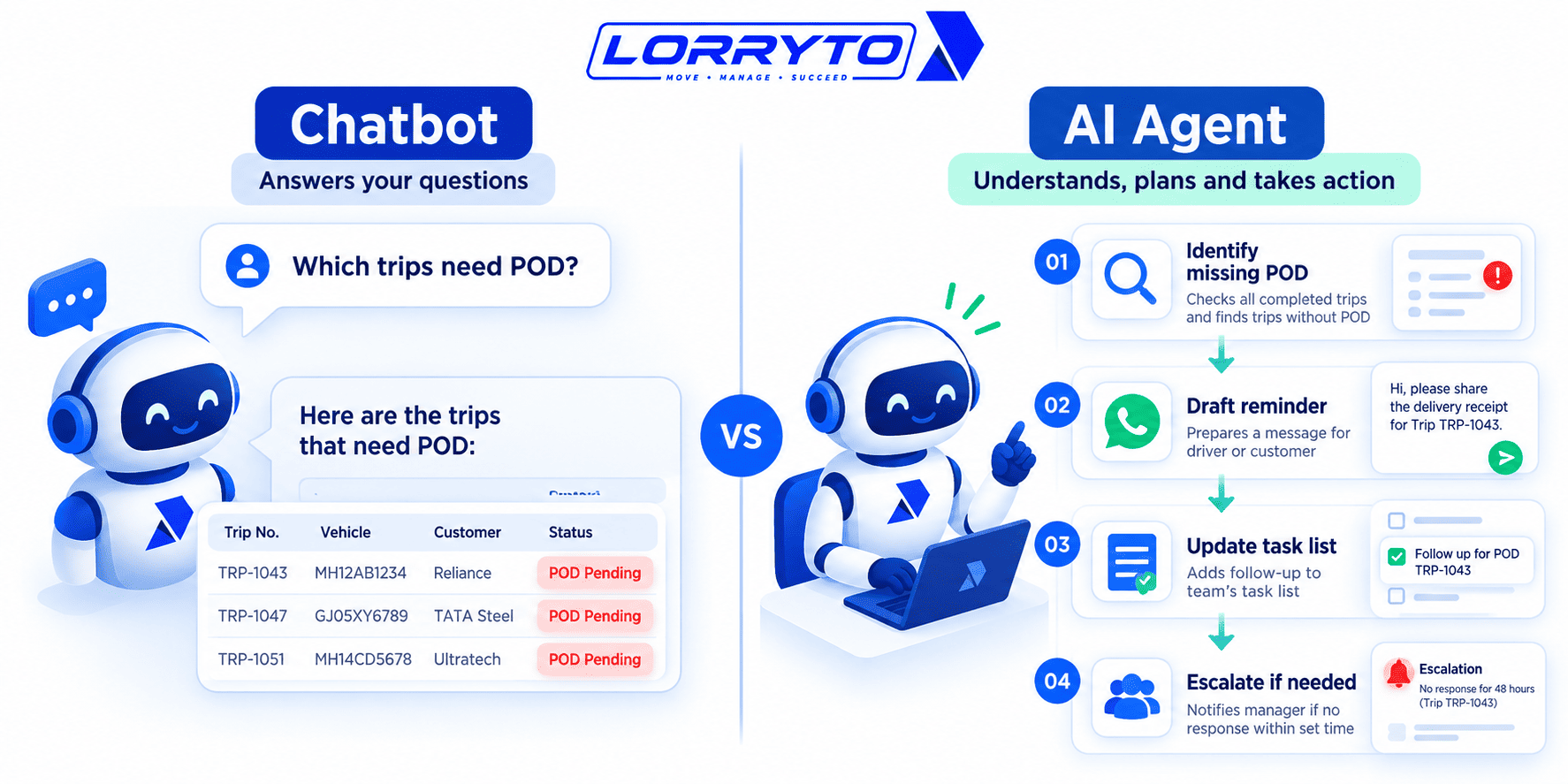
For example, a conventional chatbot could explain how to follow up on a pending delivery receipt. An AI agent connected to a transport management system could identify trips with missing receipts, check their delivery status, prepare reminders and update the relevant task list.
The difference is not simply that one system is smarter than another. It is that an agent can participate in the workflow rather than stopping at a recommendation.
This shift is gaining attention across the logistics industry. In its September 2026 report, DHL Logistics Trend Radar 8.0, DHL identified agentic AI as one of the important trends shaping the future of logistics. The report describes how AI is moving beyond analysis towards planning, decision-making and action across supply chains.
That does not mean every transport business needs an autonomous AI workforce today. It does suggest that the way logistics software handles everyday work is beginning to change.
Why does this matter for Indian transporters?
Running a goods transport business involves much more than moving a truck from one location to another.
A transporter must coordinate bookings, vehicle availability, drivers, freight rates, loading schedules, delivery documents, customer communication, expenses and payments. In many businesses, these activities are spread across spreadsheets, phone calls, paper registers and WhatsApp conversations.
As the number of vehicles and customers grows, keeping everything in sync becomes harder.
The challenge is particularly relevant to smaller transport businesses, where the same person may handle several responsibilities. A missed follow-up or an incomplete document can delay the next step, even when the actual transportation has gone smoothly.
India’s logistics sector is already developing a stronger digital foundation. According to the Ministry of Commerce and Industry’s March 2025 announcement on the Unified Logistics Interface Platform (ULIP), the platform had surpassed 100 crore API transactions, connecting logistics stakeholders with data and services across multiple government systems.
Digital connectivity does not automatically create an AI agent, but it helps establish the kind of information infrastructure that more advanced automation can build upon.
For transporters, the opportunity is to connect existing operational information and reduce the manual work required to act on it.
1. Trip coordination that goes beyond tracking
Knowing where a truck is can be useful, but location alone does not tell the complete story of a trip.
A transport manager may also need to know whether the vehicle has reached the loading point, whether loading is complete, whether the driver has the required documents and whether delivery is likely to be delayed — the same gap between “where is the truck” and “what should happen next” that we explored in digital trip tracking.
An AI agent connected to reliable trip records could bring these details together and highlight what requires attention.
Suppose a vehicle is scheduled to reach a customer by the afternoon, but its latest trip update indicates a delay. The agent could flag the risk, prepare an updated estimated arrival time if sufficient data is available, and draft a message for the customer.
If the delay affects another scheduled booking, it could also alert the operations team to review the next assignment.
This is different from sending a standard notification whenever a truck moves or stops. The agent connects the event to its operational consequences.
However, it would still need dependable trip data. If the driver has not updated the status, the location feed is unavailable or the delivery estimate is unreliable, the system should report the uncertainty rather than present a guess as a fact.
2. Less time spent chasing documents
Transport documentation is another area where AI agents could be useful.
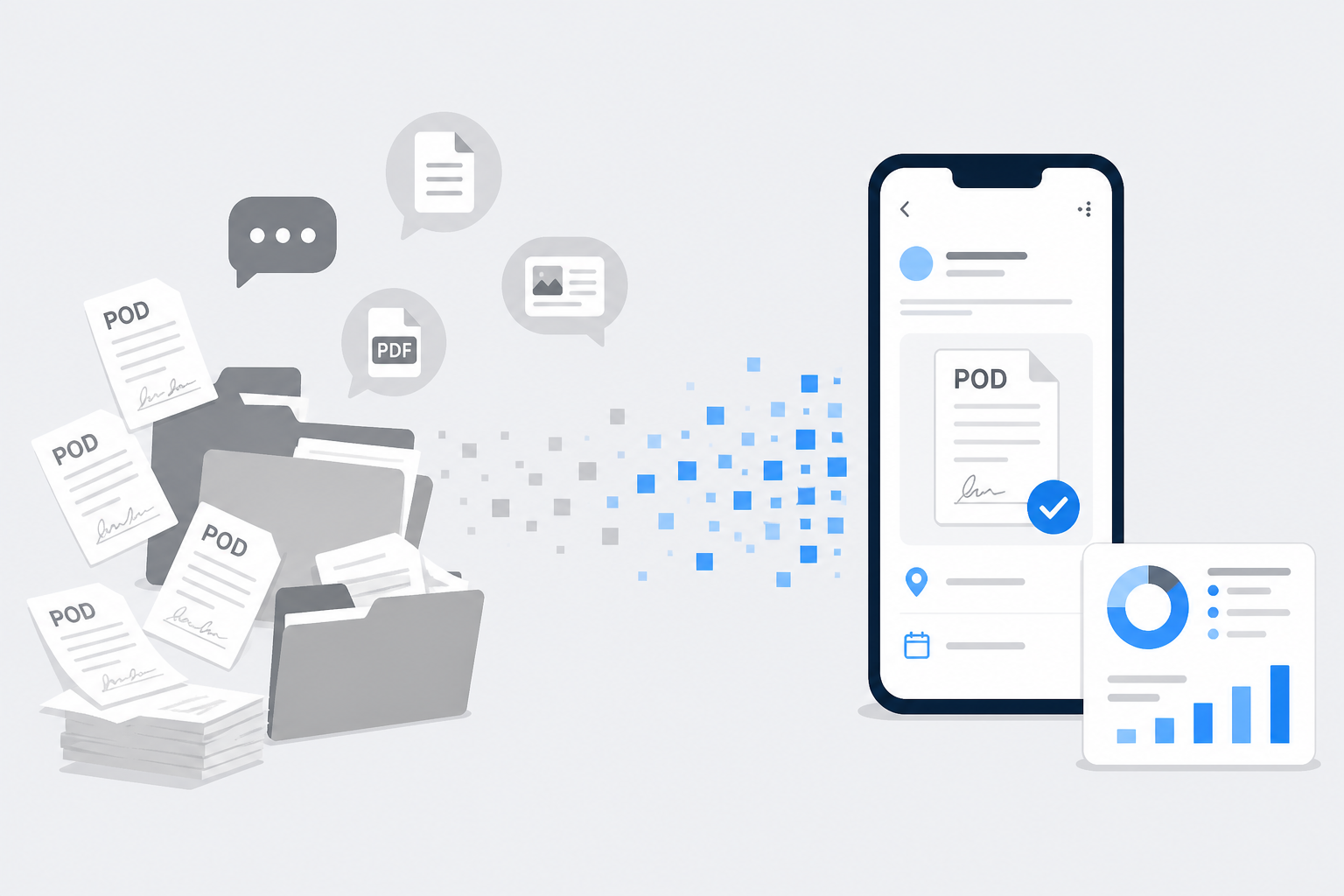
A completed trip may still require a proof of delivery (POD), a signed receipt, an invoice or other supporting documents before the transport office can close its records and proceed with billing — a workflow transporters already manage digitally with POD uploads and digital POD management.
When documents are missing, staff often have to identify the affected trip, contact the driver or customer, check whether the document has arrived and follow up again if necessary.
An AI agent could monitor trip records for missing documents and prepare a list of outstanding items. If connected to an authorised communication channel, it could draft or send reminders according to the company’s rules.
It could also help extract information from uploaded documents and compare fields such as trip references, dates, invoice numbers and amounts.
For instance, if a receipt appears to belong to a different trip, the system could flag the mismatch for review instead of automatically attaching it to the wrong record.
This is a practical use of agentic AI because the workflow is repetitive, the required information is often available digitally, and the results can be checked.
The important distinction is between identifying a problem and assuming it has been resolved. A reminder being sent does not mean the document has been received, and an uploaded document should not automatically be treated as valid without appropriate checks.
3. Better decisions before accepting a trip
A transport business can be busy without necessarily being profitable. A vehicle may complete several trips while earning less than expected because of fuel costs, tolls, waiting time, commissions or an empty return journey.
AI agents could help transporters evaluate these factors before committing to a booking — alongside the trip-level costing discipline covered in managing trip profit digitally.
Imagine receiving a freight enquiry for a particular route. An agent could retrieve the relevant vehicle details, compare the proposed rate with estimated operating costs and calculate an indicative trip margin.
It could also examine historical records for similar routes, where enough reliable data exists, to identify common delays, typical expenses or the likelihood of finding a return load.
The result could be a recommendation to accept the trip, negotiate a higher rate or review the costs before making a decision.
For example, a transporter might see that a proposed freight rate appears attractive when compared with fuel expenses alone but becomes less appealing once tolls, driver allowances, waiting time and the expected return journey are included.
This is where an AI agent could become more useful than a basic calculator. It could gather the relevant records, apply the company’s costing rules and explain which assumptions have the greatest effect on the result.
The final decision should still belong to the transporter. Freight rates change, expenses are not always predictable, and historical patterns cannot guarantee future demand.
4. Return-load planning and vehicle utilisation
Empty running remains an important operational concern for road freight businesses. When a truck delivers goods but cannot secure suitable cargo for the return journey, the transporter may incur substantial costs without earning corresponding freight revenue.
AI agents could help identify possible return loads by comparing vehicle availability, routes, delivery schedules, cargo requirements and freight offers.
A more advanced system could also estimate whether a proposed return booking makes commercial sense after considering the extra distance, pickup delays and the effect on the vehicle’s next scheduled trip.
For example, a truck completing a delivery near Pune might have several possible follow-on assignments. The best option would not necessarily be the one offering the highest freight amount. A slightly lower-paying load closer to the next destination could produce a better overall result.
To make such recommendations reliably, an agent needs access to current freight opportunities and accurate vehicle information. It cannot find a genuine return load simply by analysing the truck’s location.
Over time, transport businesses with well-maintained trip histories and access to relevant freight data could use AI to make more informed utilisation decisions.
5. Following up on payments and outstanding invoices
Cash flow is another area where routine coordination matters.
After completing a trip, a transporter may need to submit an invoice, verify supporting documents, track the payment due date and follow up with the customer if payment is delayed — the same operational rhythm covered in automating outstanding payments and creating invoices.
An AI agent could monitor these stages and identify invoices that are overdue, missing documents or awaiting an action from the transport office.
It could prepare a customer-wise outstanding summary, draft a payment reminder and alert the relevant employee when an invoice requires attention.
A transporter might ask a connected system, “Which customers have overdue payments, and which invoices are waiting for documents?”
Instead of manually checking several screens, the user could receive a consolidated answer based on the available records.
More importantly, the agent could help connect the next action to the reason for the delay. An invoice waiting for a POD needs a different response from one that has been submitted but remains unpaid.
Any payment-related action should follow clear business rules. AI can help organise information and prepare communication, but it should not independently alter financial records, approve credit or make payments without the appropriate authority.
6. What would an AI-powered transport office look like?
The potential becomes clearer when these tasks are connected.
Consider a transporter managing a fleet of vehicles and several customer accounts. A truck completes a delivery, but the POD is missing. The invoice cannot yet be finalised, and the payment process has not started.
A connected AI agent could identify the missing document, check the trip record, prepare a reminder for the driver and flag the trip for the operations team. Once the document arrives, the system could help verify the relevant details and prepare the invoice for approval.
After the invoice is issued, it could monitor the due date and bring the outstanding payment to the transporter’s attention when necessary.
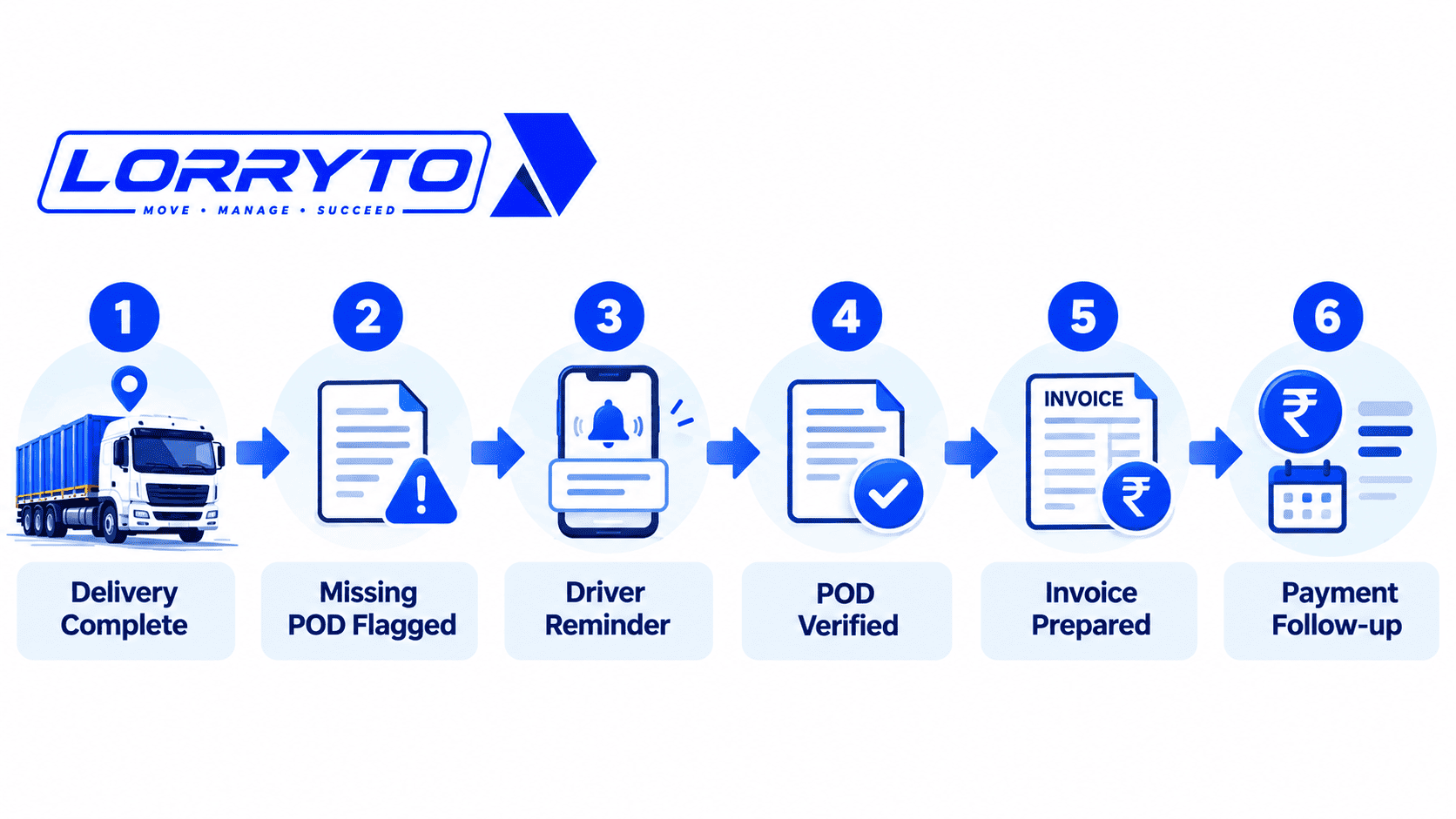
Each step depends on the previous one. The benefit comes from coordinating the entire process rather than treating trip management, documentation and billing as unrelated tasks.
This approach is already appearing in commercial logistics technology. In January 2026, Delhivery announced an autonomous transport management system under its TransportOne offering. Its official announcement, published through the National Stock Exchange, described AI agents for freight procurement, shipment planning, execution monitoring and invoice reconciliation.
Delhivery’s TransportOne product page also describes specialised agents for planning, procurement, logistics coordination, freight auditing, customer support and data analysis.
These examples demonstrate that agent-based freight operations are moving into commercial products. They do not mean every capability will be suitable for every transporter or that the same results can be assumed for a small fleet.
For smaller Indian transporters, the most practical starting point may be much simpler: an agent that identifies missing PODs, prepares trip summaries, flags overdue payments or helps staff find information quickly.
7. What are the risks and limitations?
Giving AI access to operational systems requires care. A mistake in a report is inconvenient; a mistaken vehicle assignment, incorrect invoice or unauthorised financial action can have direct business consequences.
There are several issues transporters and software providers should consider before relying on AI agents.
Incorrect or incomplete information: If trip records, vehicle availability or expenses are inaccurate, an agent may reach the wrong conclusion. Important information should be verified against the source records.
Too much autonomy: Not every task should be automated to the same degree. Preparing a report is relatively low-risk, while confirming a freight booking or changing a financial record may require human approval.
Data security: Agents should only access the information and tools needed for their assigned tasks. Customer records, driver details and financial information must be protected.
Unclear accountability: Businesses need to know what an agent did, which records it used, whether a person approved the action and how an error can be corrected.
Uncertain return on investment: AI is not automatically cheaper or more efficient. The benefits should be measured against implementation costs, staff time saved, error rates and operational outcomes.
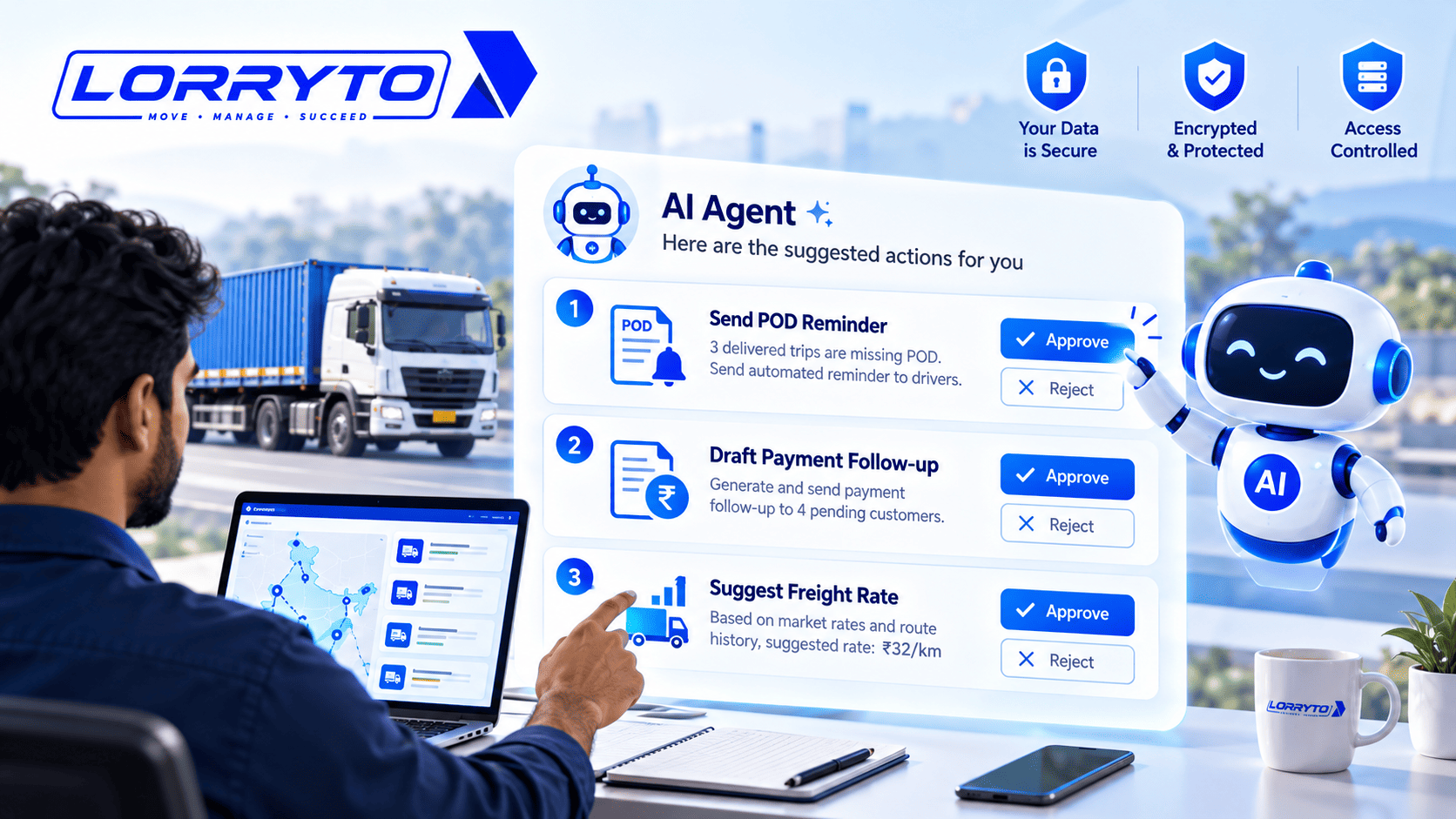
The World Economic Forum’s report, AI Agents in Action: A Playbook for Trusted Adoption, Authorization and Scaling, published in May 2026, examines how organisations can define and enforce the authority delegated to AI agents while maintaining oversight and accountability.
For a transport business, a sensible approach is to begin with low-risk tasks, measure the results and expand the agent’s responsibilities only when the workflow is reliable.
8. How transporters can prepare for agentic AI
Businesses do not need to wait for fully autonomous transport operations to benefit from better digital processes.
A useful first step is to keep trip records, vehicle details, expenses, invoices and delivery documents organised in one system. Consistent data makes it easier to identify missing information and automate repetitive tasks.
The next step is to identify activities that consume staff time but follow predictable rules. Missing-document reminders, daily trip summaries and outstanding-payment reports are good candidates.
Businesses should then establish clear approval rules. An agent may be allowed to prepare a report automatically while requiring a manager to approve a booking, modify a financial record or send a sensitive customer communication.
Finally, results should be measured. If an agent reduces the time needed to prepare daily reports but introduces frequent errors elsewhere, the workflow needs improvement before wider adoption.
India’s developing digital logistics infrastructure can also support this transition. ULIP’s growing network of logistics data integrations illustrates the direction in which the ecosystem is moving, although access to specific data still depends on the relevant systems, permissions and integrations.
The opportunity is not to automate everything at once. It is to make each part of the transport operation more connected, reliable and easier to manage.
The future of trucking will still need people
Transport is a business built on relationships, practical judgement and the ability to respond when plans change. Technology can help coordinate information, but it cannot eliminate every uncertainty on the road or replace the experience needed to handle unusual situations.
Agentic AI could gradually take over some of the repetitive work that keeps transport offices busy: checking records, identifying exceptions, preparing reports, coordinating routine follow-ups and recommending next steps.
That would allow transporters and their teams to spend more time negotiating better rates, serving customers, managing vehicles and making business decisions.
For Indian goods carriers, the next stage of digital transformation may not be about adding another dashboard. It may be about having software that helps ensure the right action happens at the right time, with the right person remaining in control.
For transporters, the real promise of agentic AI is straightforward: less time chasing routine tasks and more time running a profitable business.
How LORRYTO fits into this shift
Transport management software provides an important foundation for more connected operations. With trip records, vehicle information, expenses, invoices, documents and outstanding payments organised digitally, transporters can gain better visibility into their business today while preparing for more intelligent automation in the future.
LORRYTO helps transport businesses manage these essential workflows in one place — including LR creation, POD, trip expenses, invoicing and fleet visibility on the Vehicles list.
As AI capabilities continue to develop, connected transport data and reliable digital processes will become increasingly important to making everyday operations more efficient.
If you are ready to organise trips, documents and payments in one system, getting started with Lorryto is a practical place to begin.
Related reading
- Agentic AI in Transportation: From Tracking What Happened to Taking Action
- How Technology Is Changing the Way India Moves Goods
- Digital POD Management for Indian Transporters
- How to Manage Every Trip Tracking Digitally for Indian Transporters
- How to Manage Every Trip Profit Digitally for Indian Transporters
- How to Automate Your Transport Office Outstanding
- Getting started with Lorryto
- POD · Create invoice · Vehicles list
Sources and further reading
- DHL Group (24 September 2026) — AI takes action while people remain at the centre of logistics — Logistics Trend Radar 8.0
- Delhivery / NSE (20 January 2026) — TransportOne announces an autonomous transport management system powered by AI agents
- Delhivery — TransportOne: AI Agentic Workforce for Freight Operations
- World Economic Forum (26 May 2026) — AI Agents in Action: A Playbook for Trusted Adoption, Authorization and Scaling
- Press Information Bureau (19 March 2025) — ULIP surpasses 100 crore API transactions
Ready to run trips without registers?
Create LRs, track payments, and keep documents in one place with Lorryto — free trial available.
Start Free Now