For years, technology in the transportation industry has mainly helped companies collect information.
We have GPS tracking to know where a truck is.
We have dashboards to see trip status.
We have reports to understand costs.
We have alerts when something goes wrong.
All of this has made transportation operations more visible and more organised.
But there is still one big problem.
Someone has to look at all this information and decide what to do next.
A transport manager may have hundreds of trips running at the same time. One truck is delayed. Another driver has not updated his location. A vehicle is waiting at a loading point. A customer is asking for an ETA. A transporter has not submitted a document.
The software can show all of these problems.
But the person still has to handle them.
This is where Agentic AI could bring a major change to transportation and logistics.
What is Agentic AI?
The easiest way to understand Agentic AI is to compare it with the AI tools we already use.
A normal AI assistant can answer a question such as:
“Which of my trips are delayed?”
It can analyse the data and give you an answer.
An AI agent can go one step further.
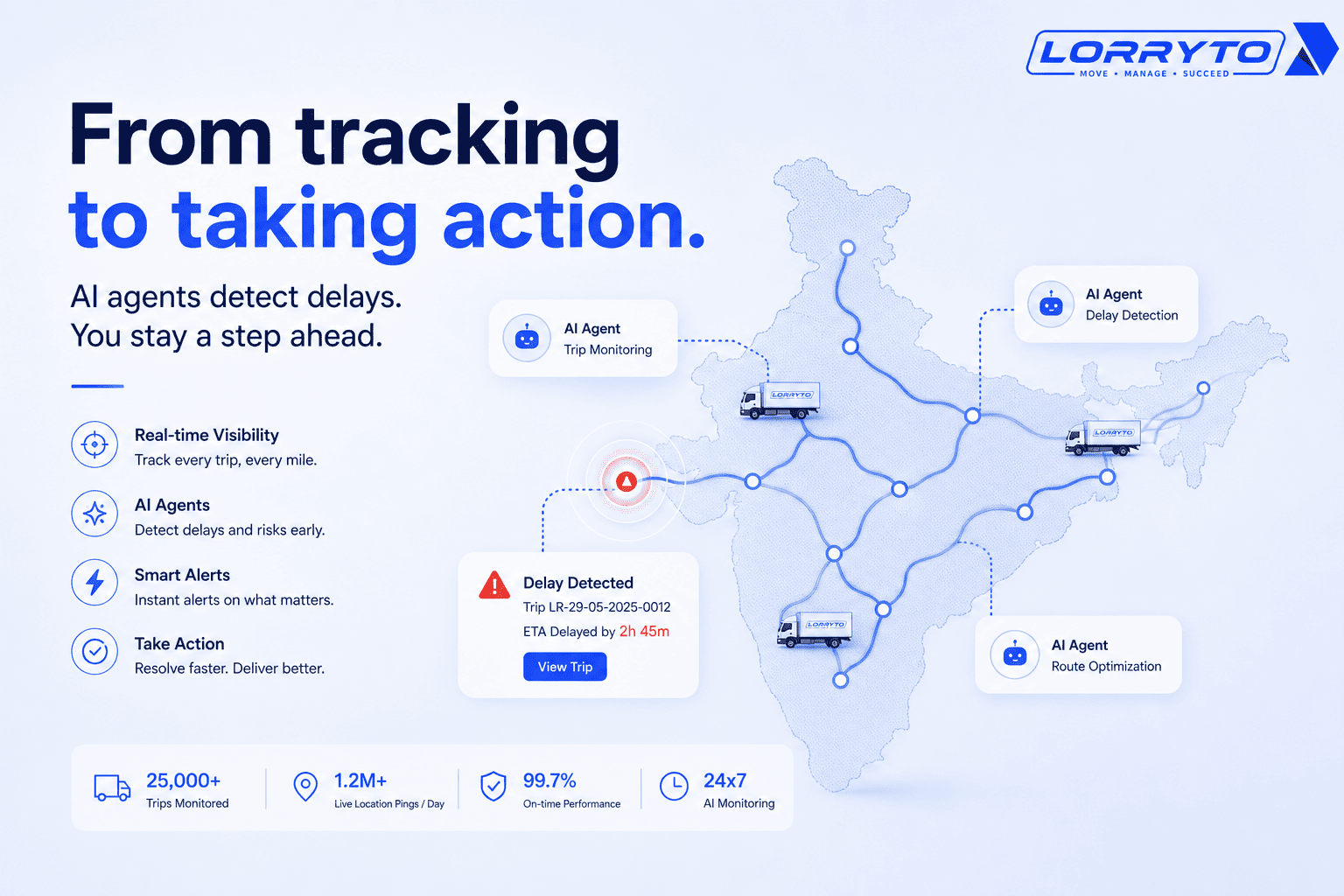
It can identify the delayed trip, understand why it is delayed, contact the relevant person, collect an updated ETA, update the system, and alert the customer if necessary.
In simple words:
Traditional software tells you what is happening.
Agentic AI can help decide what should happen next and take that action.
This is why Agentic AI is becoming an important topic in supply-chain technology. Gartner has identified Agentic AI as one of the top supply-chain technology trends for 2026, describing it as a move toward systems that can plan, act, and adapt to achieve goals rather than simply provide information.
Industry analysts also expect spending on supply-chain management software with agentic AI capabilities to grow sharply over the next several years — a sign of where logistics technology is heading.
Why is this important for transportation?
Transportation is full of small decisions.
A truck does not simply travel from Point A to Point B. There are dozens of things happening in between.
A driver may be delayed because of traffic.
A vehicle may be waiting for loading.
The consignee may not be ready to unload.
A transporter may not have confirmed the vehicle.
A customer may ask for an updated delivery time.
A POD may still be pending.
A payment may be overdue.
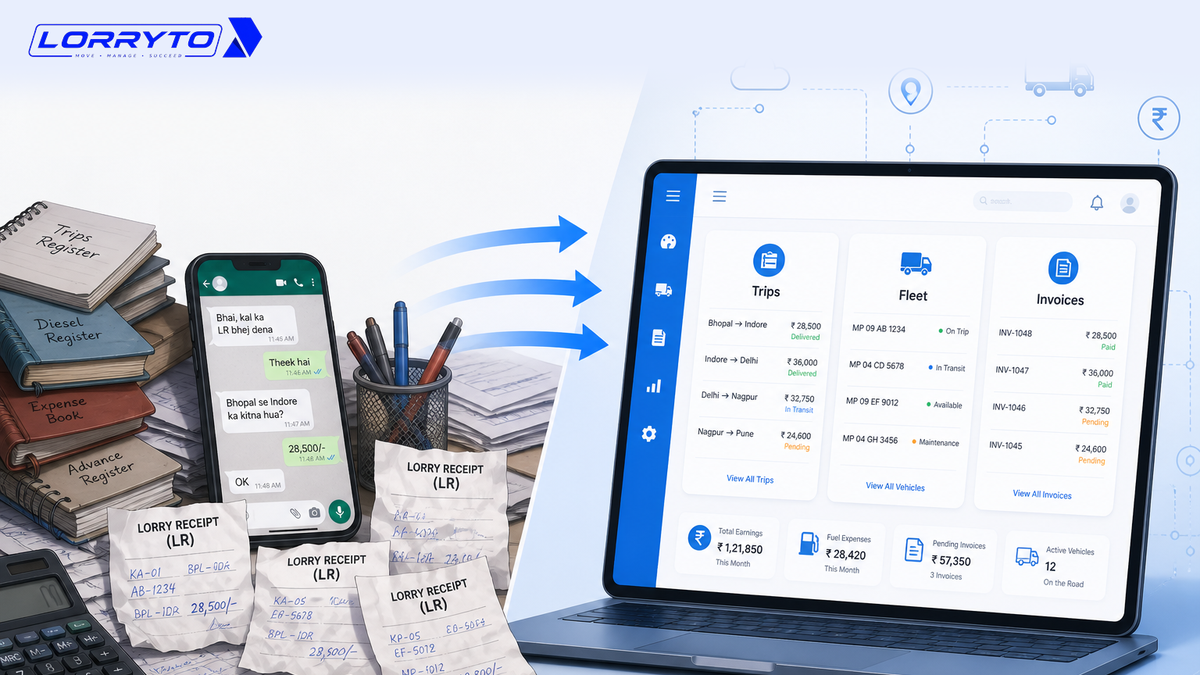
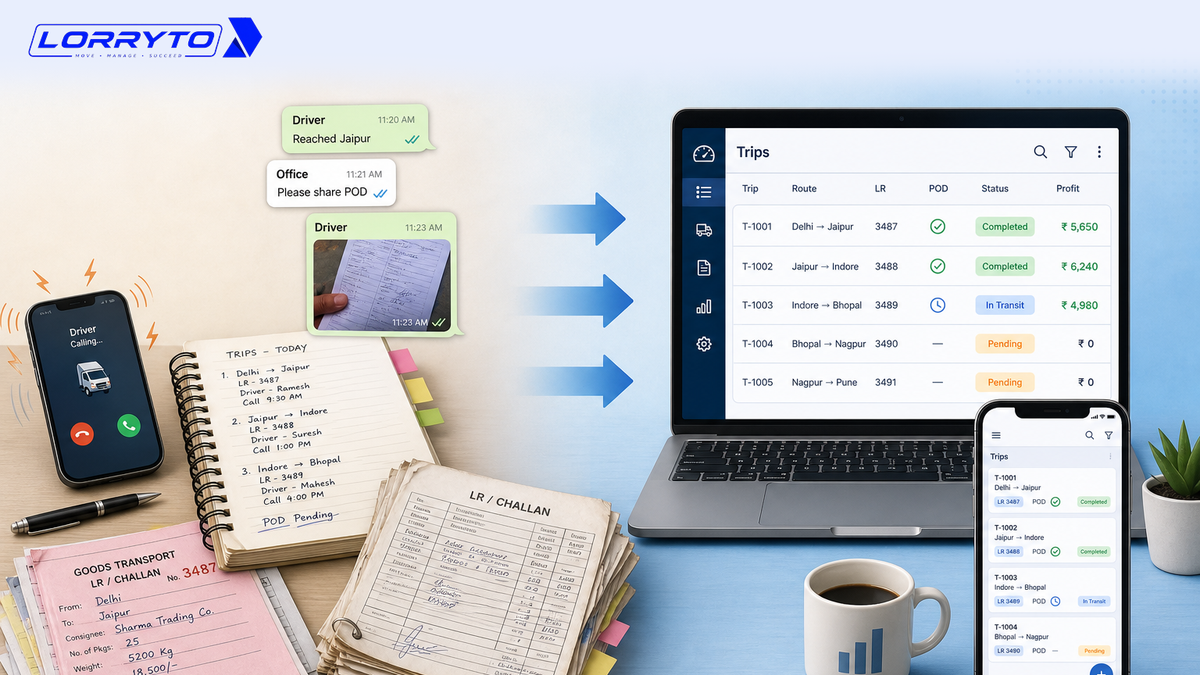
Today, many companies manage these situations through phone calls, WhatsApp messages, spreadsheets, and manual follow-ups.
The problem is not necessarily a lack of data.
The problem is that there is too much data and too many small actions that need human attention.
Agentic AI can potentially sit between the data and the people responsible for operations.
It can continuously look for exceptions, understand what needs attention, and help execute the next step.
For transport companies, this also means that the software they already use can become increasingly important. A transport management platform such as Lorryto, for example, can bring operational information such as trips, vehicles, transporters, and day-to-day activities into one system. As AI becomes more capable, having structured and accessible operational data becomes an important foundation for building smarter workflows.
The AI cannot make a useful decision if it does not have reliable information about what is happening. That is one reason digitization and clean trip records matter before any agent layer is added.
Imagine a normal transport operation
Suppose a truck is scheduled to deliver a shipment tomorrow morning.
The truck is expected to reach the destination by 8:00 AM.
At 11:00 PM, the vehicle has stopped for several hours and is still far from the expected location.
A traditional system may simply show:
Trip delayed.
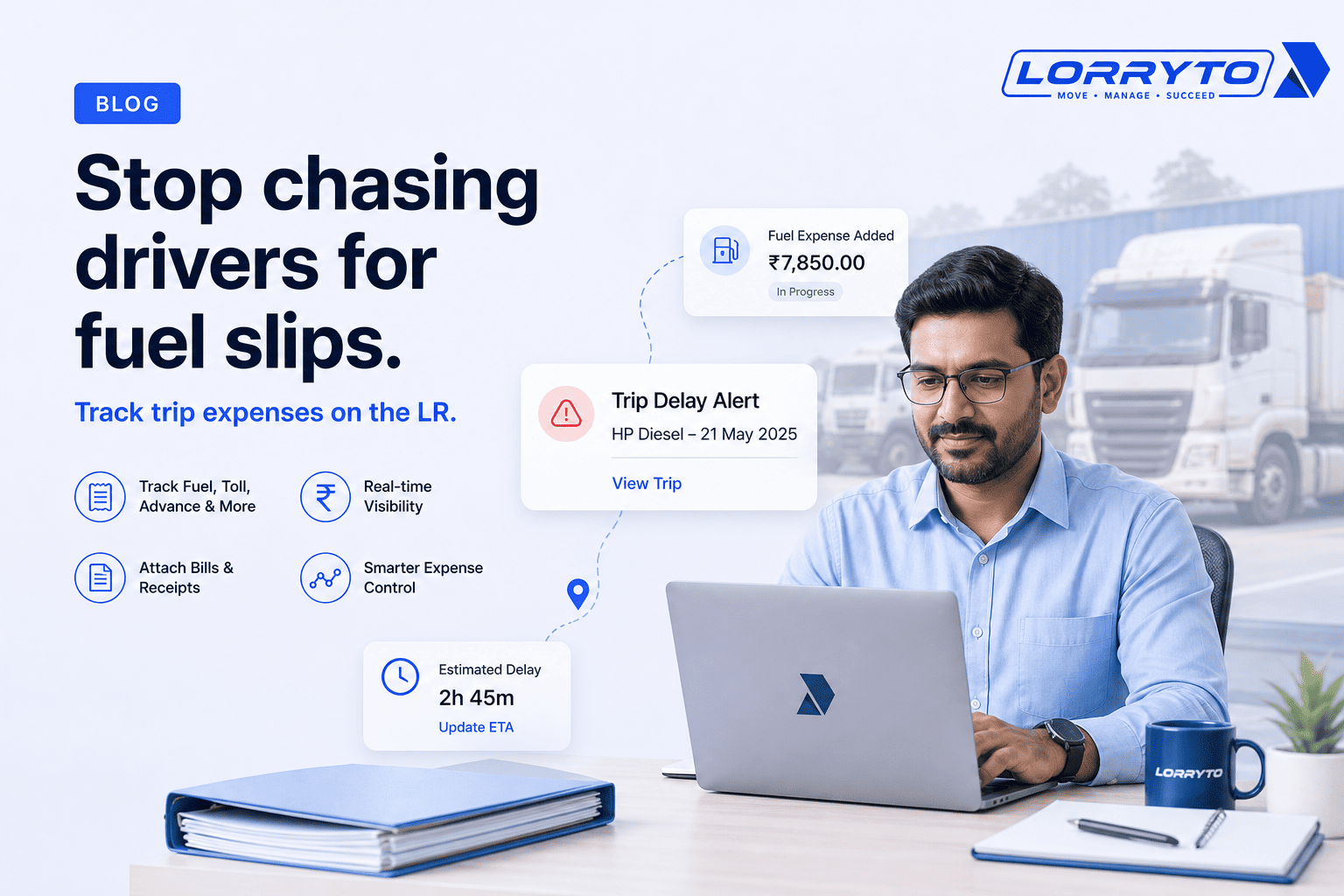
The transport manager then has to notice the alert, call the driver, find out what happened, calculate the new ETA, inform the customer, and update the system.
Now imagine an AI agent handling the first part of this process.
It notices that the vehicle has stopped.
It checks the planned route and expected arrival time.
It looks at the available information and identifies that the shipment is likely to miss its delivery window.
It contacts the driver or transporter for an update.
Once it receives the information, it updates the trip status and prepares a revised ETA.
If the delay crosses a defined limit, it can escalate the issue to the transport manager.
The manager is still in control.
But instead of spending time finding the problem, the manager receives a problem that has already been identified and partially handled.
That is the real promise of Agentic AI in transportation.
For context on what today’s tracking software already does — before any agent layer — see Trip tracking digitally.
From one AI assistant to a team of AI agents
The next interesting development is that companies may not use one large AI agent to handle everything.
Instead, different agents can handle different jobs.
For example:
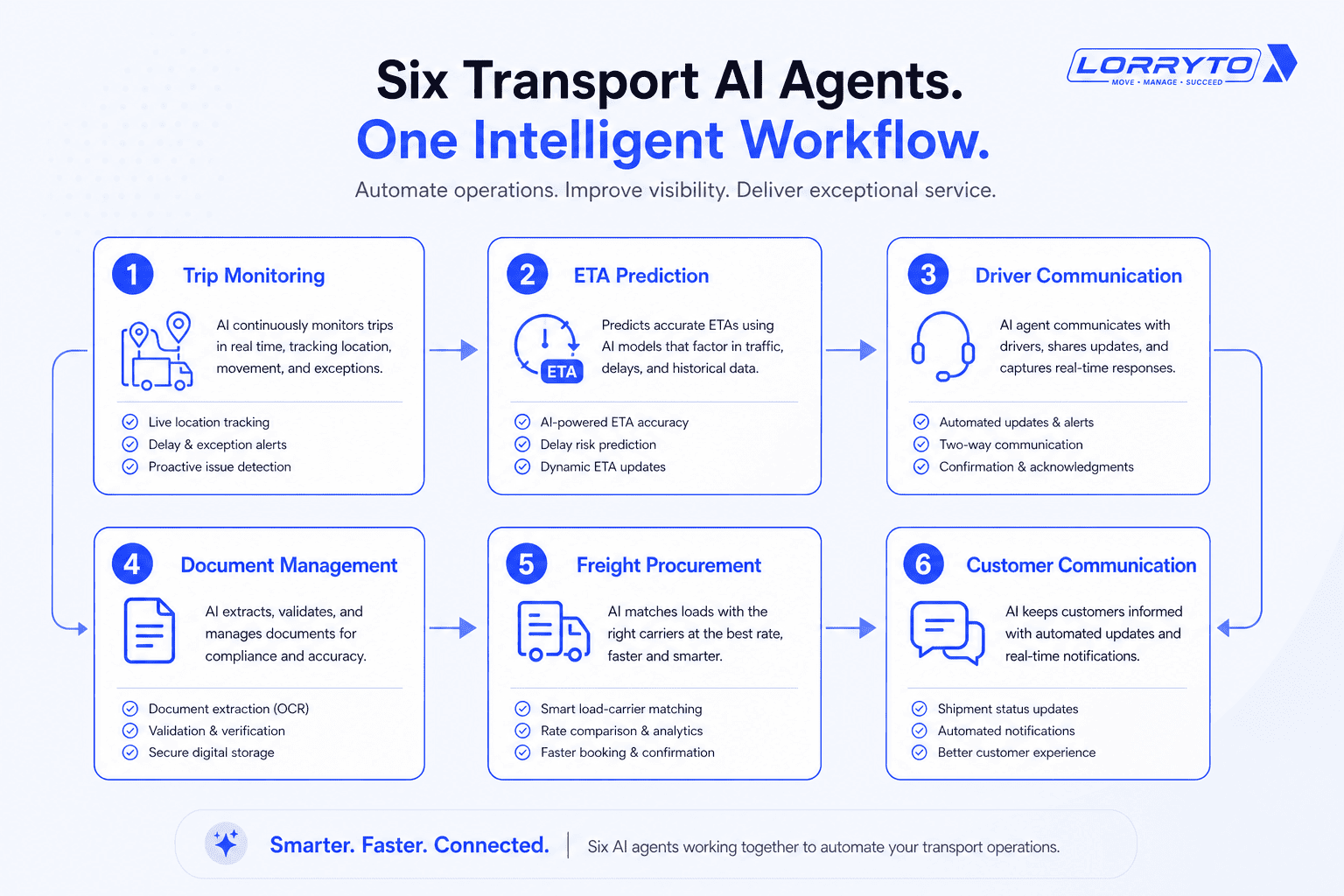
- Trip Monitoring Agent — watches active trips and identifies delays or unusual situations
- ETA Agent — continuously checks whether vehicles are likely to reach their destination on time
- Driver Communication Agent — handles routine follow-ups and collects missing updates
- Document Agent — checks whether PODs, invoices, and other required documents have been received
- Freight Procurement Agent — looks at available carriers, rates, and performance when selecting transporters
- Customer Communication Agent — prepares and sends updates when a shipment is delayed or its ETA changes
These agents can then work together.
This is not only a theoretical idea anymore. In 2026, logistics technology providers are already introducing specialised AI agents for areas such as network operations, carrier communication, exception management, and freight procurement. project44 has launched an AI agent portfolio covering workflows from freight procurement to disruption response and carrier onboarding.
The important point is that these agents are being designed around specific operational jobs, rather than simply acting as general-purpose chatbots.
The shift from dashboards to action
This may be the biggest change.
For many years, transport software has been built around dashboards.
A platform such as Lorryto can help bring transport operations into one place, making it easier for teams to manage trips, vehicles, transporters, and day-to-day activities.
But the next step is not simply adding more dashboards.
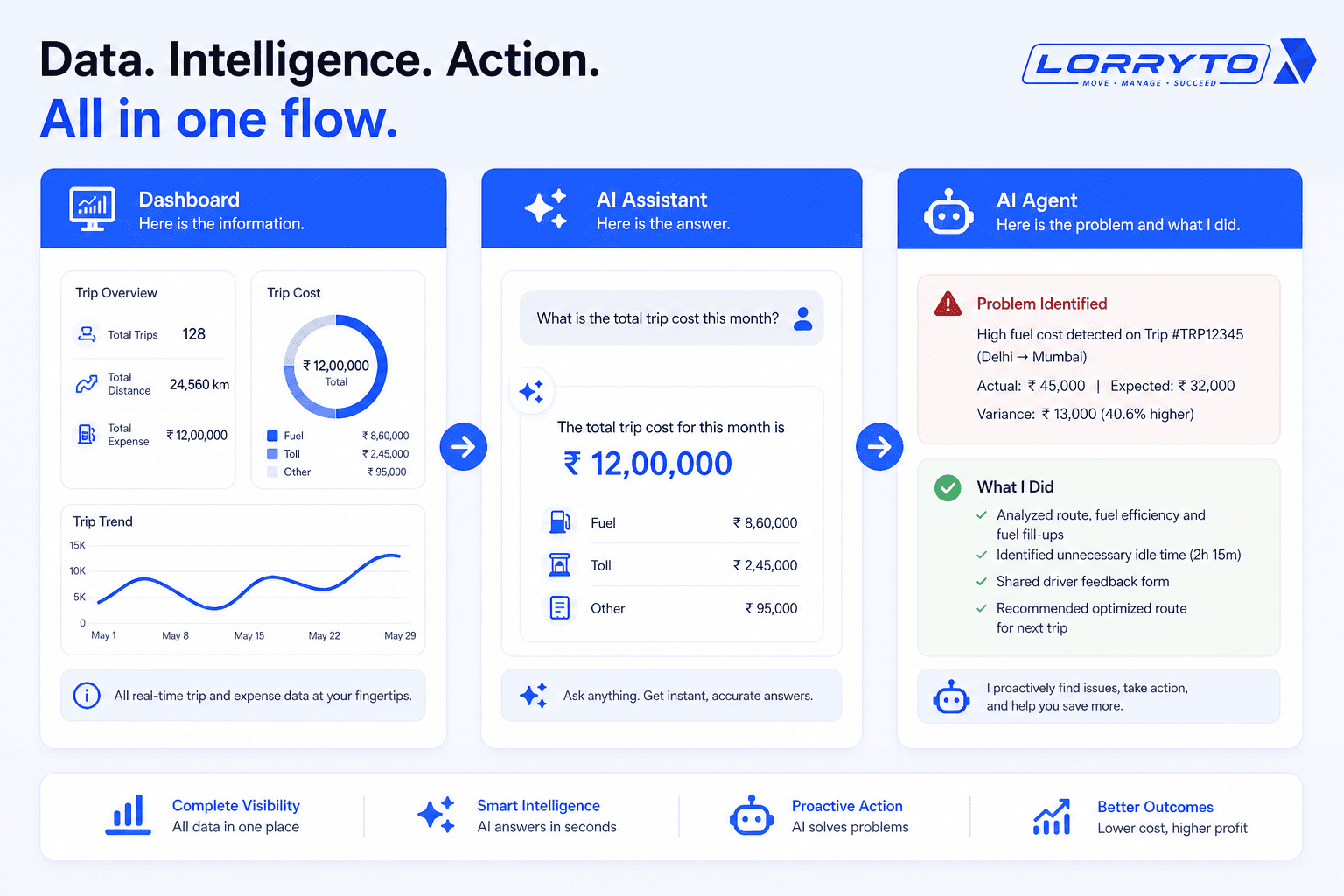
A dashboard might show:
- 120 active trips
- 8 delayed trips
- 15 pending PODs
- 6 vehicles waiting for loading
- ₹X outstanding payments
This is useful.
But someone still needs to go through the list.
Agentic AI changes the approach.
Instead of asking the manager to search through 120 trips, the system could say:
“There are 3 trips that need attention right now.”
It can explain why they need attention and suggest what should be done.
The manager can then approve an action, change it, or allow the system to handle it automatically within predefined rules.
This is a much more natural way of working.
The difference is simple:
| What you get | |
|---|---|
| Dashboard | Here is the information. |
| AI assistant | Here is the answer. |
| AI agent | Here is the problem, here is what I recommend, and here is what I have already done. |
That is a significant shift in how transportation software could be used.
Freight procurement is another major opportunity
Agentic AI is not only useful after a truck starts moving.
It can also help before a trip begins.
Choosing the right transporter is often a combination of price, availability, service quality, and past performance.
A human team may spend hours calling transporters, collecting rates, and comparing options.
In February 2026, project44 introduced an AI Freight Procurement Agent designed to automate activities such as carrier selection, rate benchmarking, and negotiations while keeping teams in control. The company says the system can continuously evaluate market conditions and carrier performance rather than relying only on periodic bid cycles.
This points toward a future where software does not simply show available transporters.
It can actively help find the best option.
For example:
“Transporter A is cheaper, but its recent on-time performance on this route is lower. Transporter B costs slightly more but has a stronger delivery record. Based on your current rules, Transporter B is the better option.”
That is much closer to having a digital operations assistant than having another software dashboard.
What about human jobs?
This is probably the first question people will ask.
Will Agentic AI replace transport managers, dispatchers, or operations teams?
The more realistic answer is that, at least in the near term, it is more likely to change their work than completely replace them.
Transportation involves situations that cannot always be solved by a fixed rule.
A customer may have an urgent requirement.
A driver may have a genuine problem.
A transporter may need special consideration.
A major shipment may require a business decision rather than an automated response.
AI can handle repetitive work.
People can handle exceptions, relationships, and decisions that require judgment.
The goal should not be:
AI instead of people.
It should be:
AI handling more routine work so people can focus on important work.
This human-in-the-loop approach is also important because transportation decisions can have financial and operational consequences. Even as AI agents become more capable, companies still need clear rules around what an agent can do on its own and what requires human approval.
But Agentic AI is not magic
There is also a reason companies should not rush into putting AI agents everywhere.
An AI agent is only as useful as the information it can access.
If vehicle data is incomplete, transporter information is outdated, trip statuses are not updated, and different systems do not communicate with each other, the AI will struggle to make good decisions.
This is one of the biggest lessons emerging from the current development of enterprise AI agents.
Gartner has warned about “agent washing” — the practice of describing software as agentic when it does not actually provide meaningful autonomous capabilities. Its guidance is to focus on proven use cases and strengthen data, integration, and governance foundations before moving toward greater autonomy.
This is an important point.
Companies should not add an AI agent simply because “AI” sounds impressive.
The question should be:
What problem is the agent actually solving?
And just as importantly:
What information does it need to solve that problem reliably?
Where should transportation companies start?
The best approach may be to start small.
Instead of trying to build an AI system that controls the entire transport operation, companies can begin with repetitive tasks.
For example:
- Identify delayed trips
- Automatically follow up for missing updates
- Predict whether a shipment will miss its ETA
- Remind drivers or transporters about pending documents
- Identify trips that require human attention
- Compare transporter performance
- Help with freight rate comparison
- Prepare customer updates automatically
These are practical areas where AI can reduce repetitive work without immediately handing over complete control of the operation.
Once these systems become reliable, multiple agents can be connected together.
That is when the bigger opportunity begins.
If your operation is still on paper and WhatsApp, the first step is getting trips and documents into one digital record — see Getting started and Paperless transport office.
The future of transportation software
The transportation software of the future may look very different from today’s software.
Today, a transport manager may open a system and search for information.
Tomorrow, the system may come to the manager.
Instead of:
“Let me check which trips are delayed.”
It could become:
“Three trips are at risk of missing their delivery windows. Two have already been contacted. One needs your approval before we change the transporter.”
Instead of:
“Let me compare transporter rates.”
It could become:
“I found four suitable transporters. Based on your rate, performance, and availability rules, I recommend Transporter B.”
Instead of:
“Let me check pending PODs.”
It could become:
“Seven PODs are still pending. Five reminders have been sent automatically. Two need manual follow-up.”
This is the shift from software that records operations to software that participates in operations.
And this is where existing transport management platforms can become more valuable. The data already captured through trips, vehicles, transporters, documents, and operational workflows can provide the context that future AI agents need to make useful decisions.
For companies such as Lorryto, this creates an interesting direction for the future: not simply adding AI as another feature, but gradually making the entire transport workflow more intelligent — built on the structured records teams create today.
Agentic AI could become the next major layer of transport technology
Transportation has already gone through several technology phases.
First came basic computerisation.
Then transport management systems.
Then GPS and real-time tracking.
Then mobile applications, cloud software, and connected fleets.
Now the industry is moving toward AI.
But Agentic AI could represent something different from previous upgrades.
It is not simply another feature added to a transport management system.
It could change how the entire system is used.
The biggest opportunity may not be creating another dashboard with more information.
It may be creating software that understands what is happening, identifies what matters, recommends what should happen next and — within clearly defined limits — takes action.
The industry is already beginning to move in this direction. In 2026, logistics platforms are deploying AI agents that continuously monitor operations, contact carriers, resolve data issues, and automate procurement workflows. project44, for example, reports that its agents have been used for large volumes of automated carrier communications, with customers citing reductions in manual coordination and faster sourcing cycles in early deployments.
But the transition will not happen overnight.
The most successful approach is likely to be gradual: start with simple, measurable workflows, keep people involved where judgment matters, build reliable data foundations, and expand automation as confidence grows.
For transport companies, this could mean fewer manual follow-ups, faster responses to problems, and more time for teams to focus on decisions that actually require human attention.
The future of transport software may not be about giving people more information.
It may be about giving them fewer things to do.
References and next reads: Digitization in India · Trip tracking digitally · Trip reports digitally · Paperless transport office · Getting started · Gartner supply-chain tech trends 2026 · Gartner on agent washing · project44 AI agent orchestration · project44 Freight Procurement Agent
Ready to run trips without registers?
Create LRs, track payments, and keep documents in one place with Lorryto — free trial available.
Start Free Now