For a long time, a truck was mainly a mechanical machine.
An engine, a gearbox, a chassis, a driver, and a load.
The focus was simple: carry more, travel farther, consume less fuel, and keep the truck running.
But trucks are changing.
Today, a modern commercial vehicle can have sensors, telematics, connectivity, software, and artificial intelligence working alongside its traditional mechanical systems. It can collect information about how it is being driven, understand road and load conditions, monitor its own health, and provide information that helps fleet operators make better decisions.
The truck is no longer just carrying the cargo.
It is also generating information about the journey — and increasingly using that information to work more intelligently.
This is the beginning of what many in the industry are calling the intelligent truck.
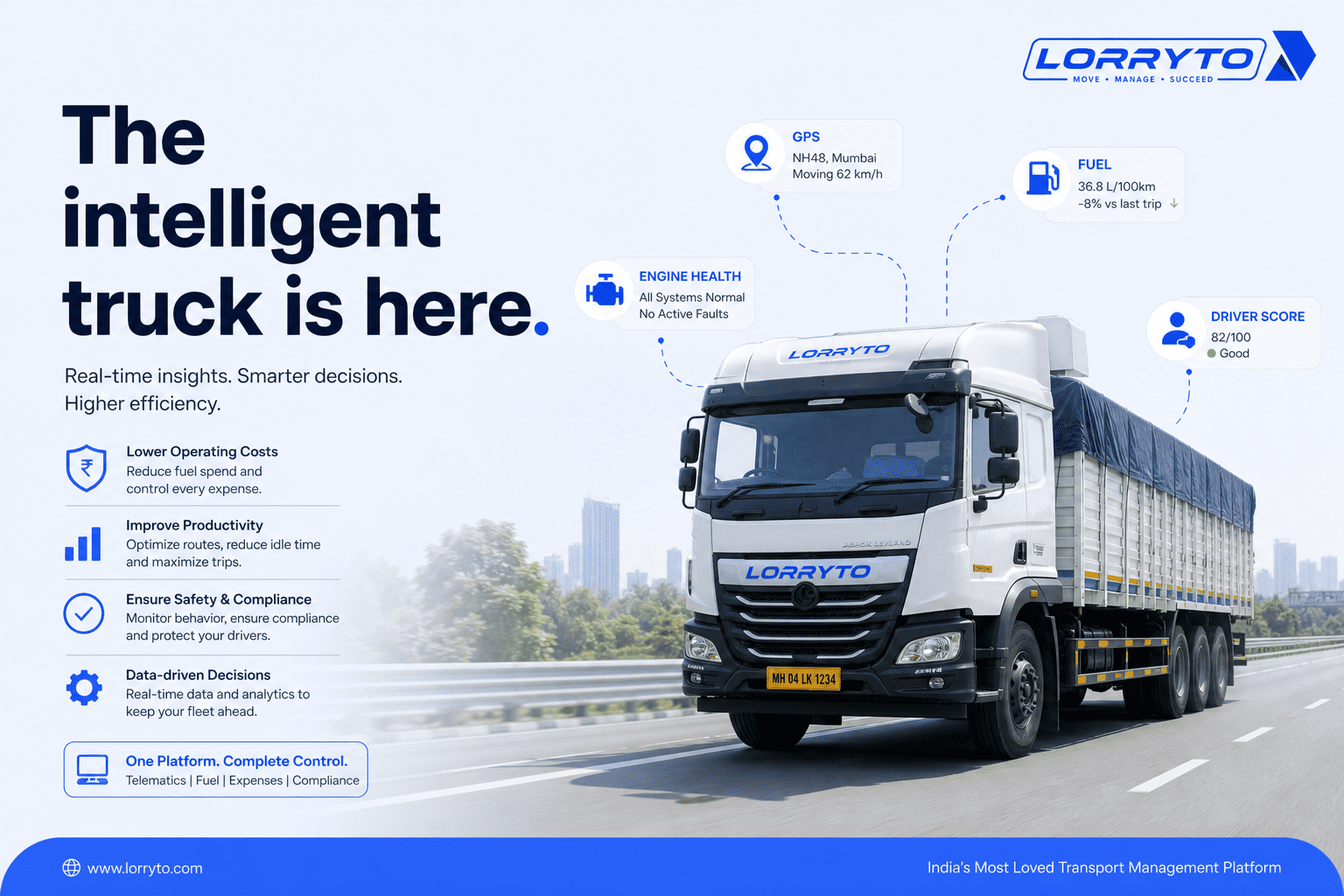
From a mechanical machine to a connected vehicle
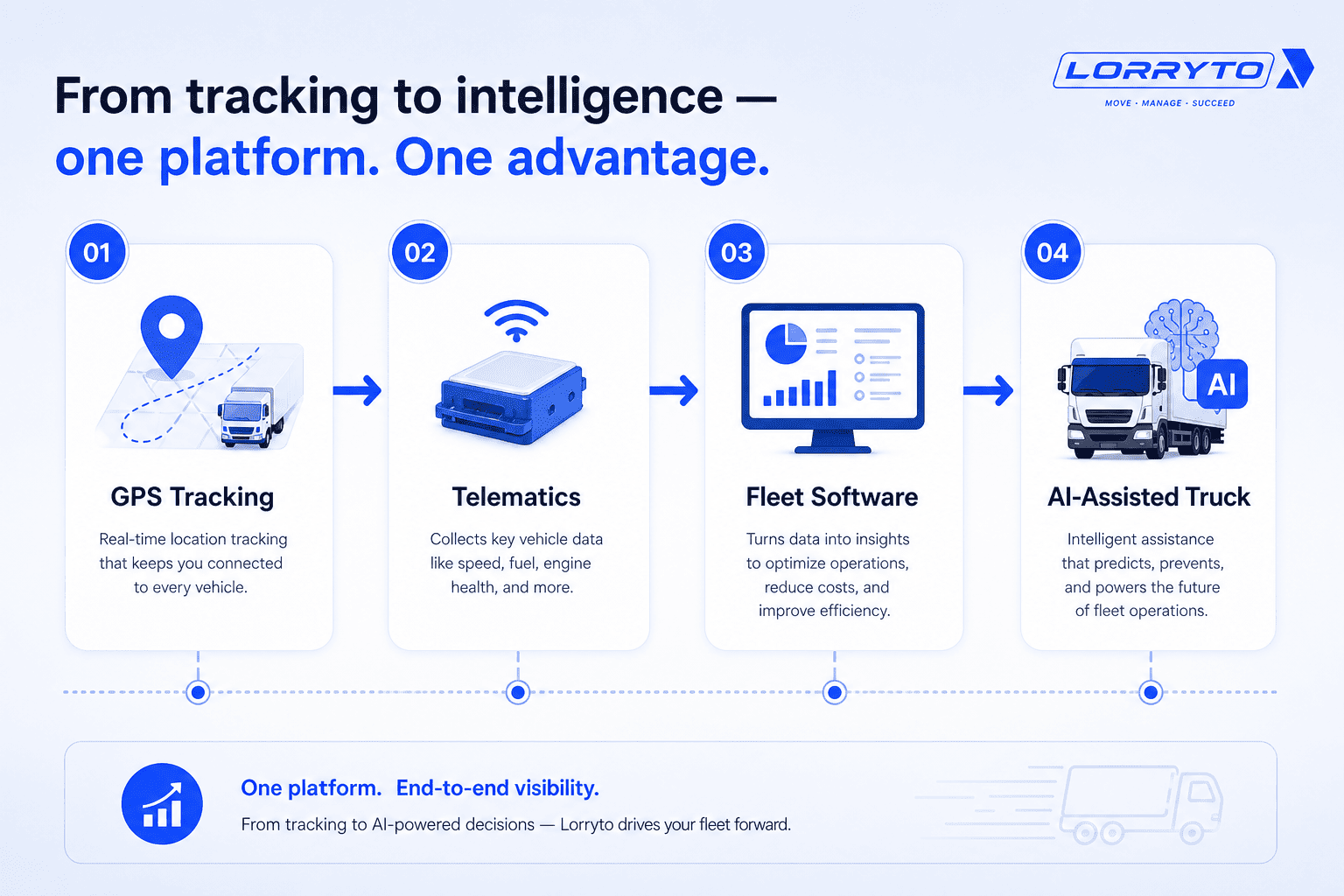
The first major change came with GPS.
For the first time, fleet owners could see where their trucks were instead of depending entirely on phone calls from drivers.
Then came telematics.
Operators could start looking at fuel consumption, speed, vehicle usage, driver behaviour, and other operational information.
Fleet-management software brought another layer. Instead of looking at one truck at a time, companies could manage information across an entire fleet.
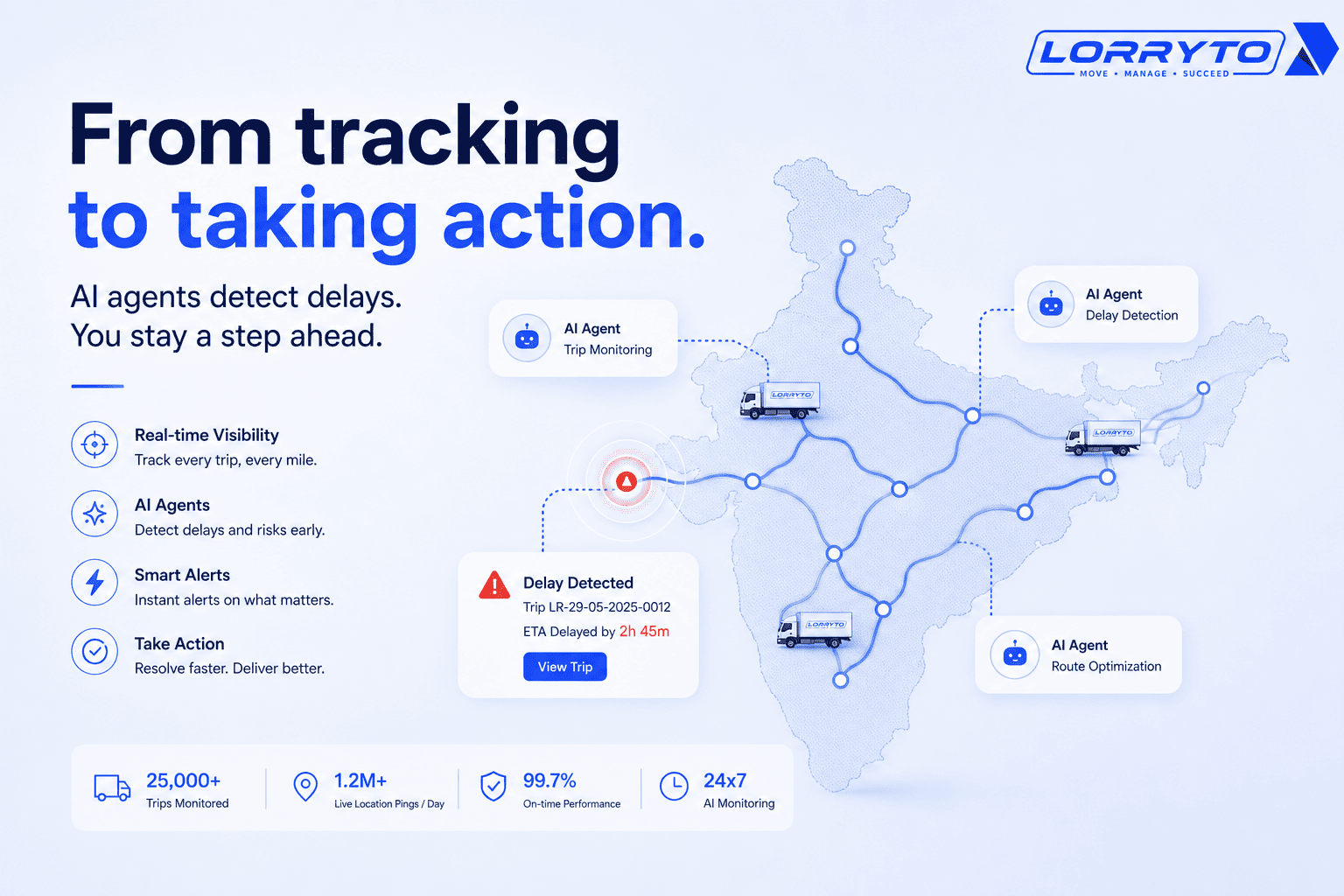
Now artificial intelligence is beginning to connect these pieces.
The difference is important.
Traditional systems mainly answer questions such as:
Where is my truck?
How fast is it travelling?
How much fuel has it consumed?
When is its next service due?
AI can take this information a step further.
It can help identify patterns, understand changing conditions, and recommend or perform certain actions.
So the question starts changing from:
“What is happening with my truck?”
to:
“What should happen next?”
That is where the intelligent truck becomes interesting.
AI is already entering Indian trucks
This is not simply a prediction about the distant future.
In August 2026, Mahindra launched the BLAZO i-TRK, positioning it as a new generation of intelligent heavy commercial vehicles in India.
One of its key technologies is iFuelSmart, which Mahindra describes as an AI-enabled automatic drive mode. The system continuously analyses factors such as road gradients, payload, and driving conditions and automatically selects the appropriate driving mode.
The idea is straightforward: instead of relying entirely on the driver to decide which operating mode is most suitable at every point of the journey, the truck can use the available data to assist with that decision.
The BLAZO i-TRK also uses Mahindra’s iMAXX 2.0 connected vehicle platform, which provides fleet visibility, vehicle-health information, driver analytics, and other operational insights.
This is an important step.
The truck is no longer simply reporting what happened after a trip.
Technology is being used during the trip to help the vehicle operate more efficiently.
Source: Mahindra BLAZO i-TRK press release (August 14, 2026).
The truck is becoming a data source
Think about what happens during a single journey.
A truck may travel hundreds of kilometres.
During that time, it can generate information about:
- Location
- Speed
- Fuel consumption
- Engine performance
- Driver behaviour
- Vehicle health
- Road conditions
- Load conditions
- Stoppage time
- Route performance
A few years ago, much of this information was either not available or was reviewed only after the journey.
Connected trucks can make much more of this information available in real time.
That creates a new opportunity.
Instead of waiting until something goes wrong, operators can start looking for signs that something may go wrong.
For example:
“Fuel consumption on this vehicle has changed significantly from its normal pattern.”
Or:
“This vehicle may require attention based on its current health data.”
Or:
“The current driving pattern is affecting fuel efficiency.”
The real value is not in collecting hundreds of data points.
The value comes from turning those data points into something useful.
For how transport offices track trips today — before any deeper vehicle-AI layer — see Trip tracking digitally.
From driver experience to AI-assisted driving
The driver will remain an important part of transportation for a long time.
But the driver’s experience can increasingly be supported by technology.
Consider a truck travelling through a route with changing gradients, traffic, road conditions, and payload.
A driver has to make decisions continuously.
An intelligent system can analyse some of the same conditions and assist with those decisions.
Depending on the vehicle and technology, this can include:
- Selecting an appropriate driving mode
- Supporting fuel-efficiency decisions
- Monitoring driving behaviour
- Providing safety warnings
- Assisting with braking or collision avoidance
- Monitoring vehicle conditions
- Identifying potential maintenance issues
The purpose does not have to be replacing the driver.
It can simply be giving the driver better information and better assistance at the right time.
That distinction is important.
The future of trucking does not necessarily have to be:
Human vs AI.
It can be:
Human + AI.
A smarter approach to fleet maintenance
One of the most practical uses of connected vehicle data is maintenance.
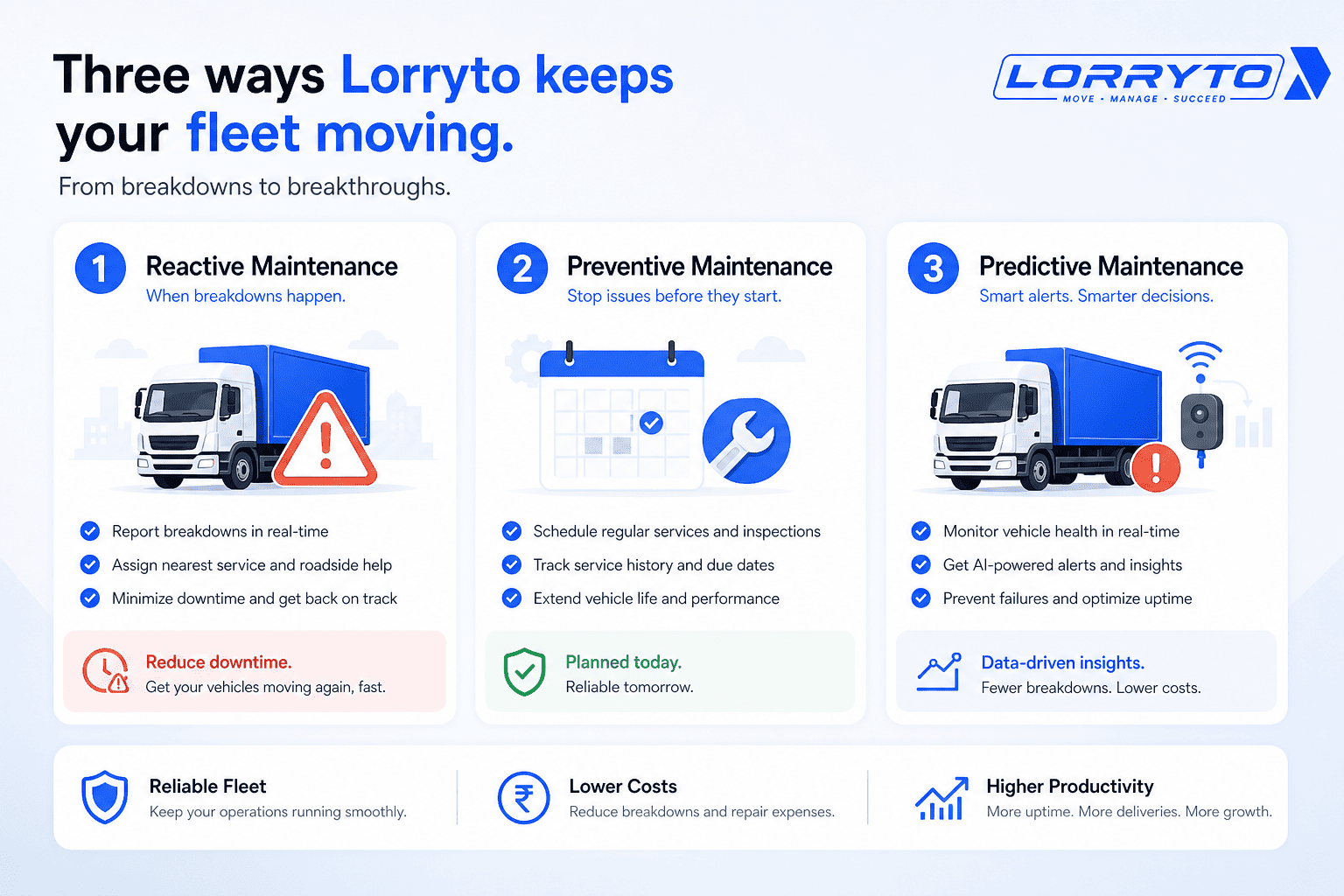
Traditionally, fleet maintenance has largely followed two approaches.
The first is reactive:
Something breaks → repair it.
The second is preventive:
The vehicle reaches a certain mileage or service interval → service it.
Connected vehicles and AI introduce another possibility:
Identify signs of a potential problem before it becomes a breakdown.
For commercial fleets, this can have a significant impact.
A truck sitting in a workshop is not earning money.
An unexpected breakdown can result in:
- Lost operating time
- Delayed deliveries
- Driver downtime
- Emergency repair costs
- Customer complaints
- Missed trips
This is why vehicle-health monitoring and predictive diagnostics are becoming increasingly important parts of connected truck platforms. Mahindra’s iMAXX platform, for example, includes vehicle-health monitoring and intelligent alerts alongside other fleet information.
The goal is simple:
Know about a problem before the problem stops the truck.
For tracking repair and maintenance costs in your office records today, see Vehicle expenses.
The truck is also becoming a software platform
There is another change happening underneath all of this.
The commercial vehicle industry is gradually moving from a hardware-centric approach toward software-defined vehicles.
A 2026 SAE technical paper on the Indian commercial-vehicle industry describes this transition from traditional hardware-centric vehicles toward software-defined architectures and automotive software services.
In simple terms, software is becoming a much bigger part of what a vehicle can do.
This can eventually allow vehicles to receive new capabilities through software updates, improve diagnostics, support connected services, and integrate new AI-based functions without requiring the entire vehicle to be physically redesigned.
Technologies such as over-the-air updates, digital twins, AI-based predictive maintenance, and V2X communication are important parts of this emerging software-defined vehicle architecture.
This changes the way we think about a truck.
It is no longer simply:
Hardware + engine + driver.
It is increasingly:
Hardware + software + sensors + connectivity + data + intelligence.
But an intelligent truck alone is not enough
There is an important part of this discussion that is sometimes missed.
A transport company does not operate trucks in isolation.
A truck is connected to an entire business operation.
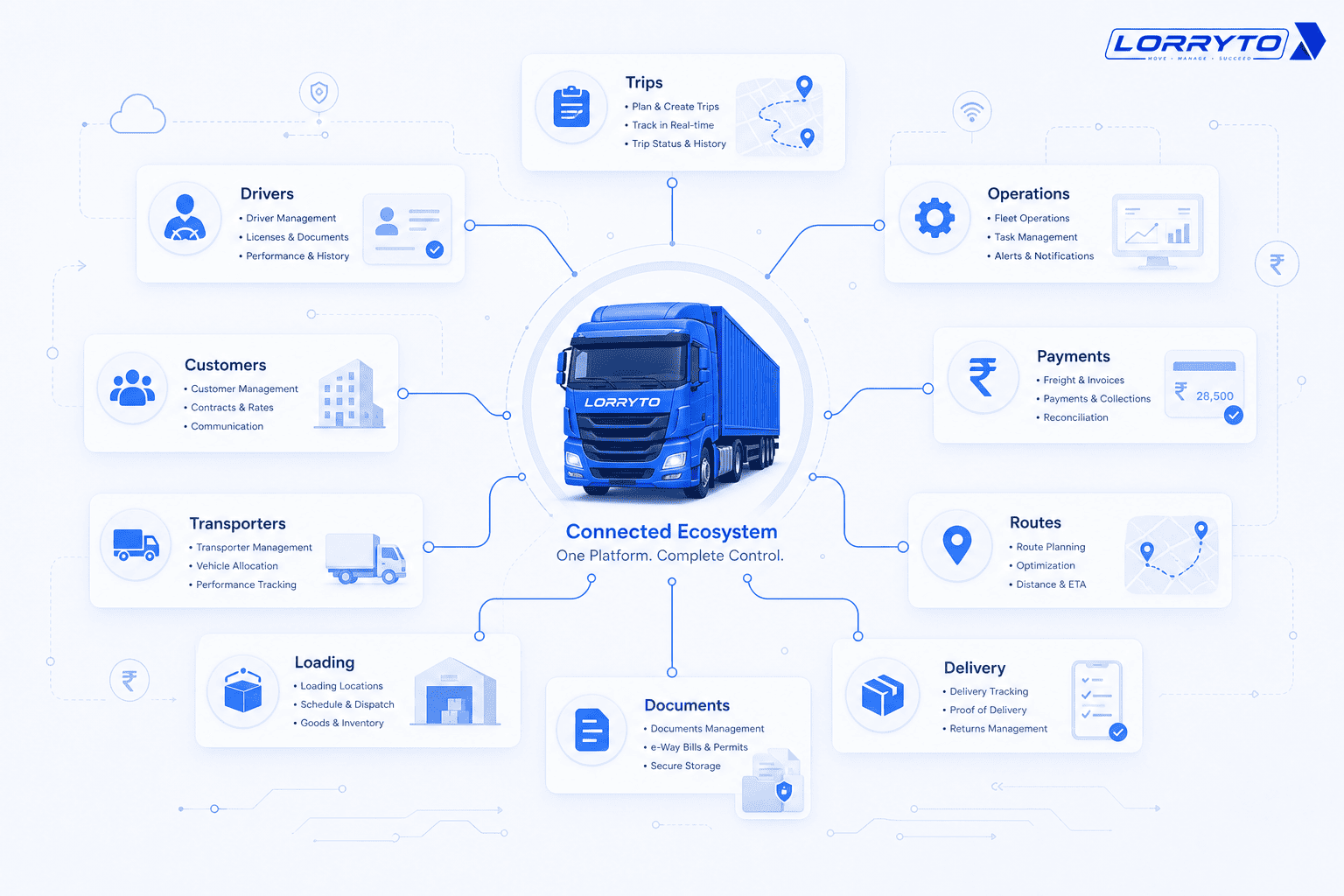
It is connected to:
- Trips
- Customers
- Drivers
- Transporters
- Loading locations
- Delivery locations
- Documents
- Routes
- Payments
- Operations teams
So making the truck intelligent is only one part of the transformation.
Imagine a truck knows:
“I am going to be late.”
That information is useful.
But the transport operation needs to know:
“This delay could affect a customer’s delivery scheduled for tomorrow morning.”
That is a much more valuable piece of information.
This is where transport-management software becomes important.
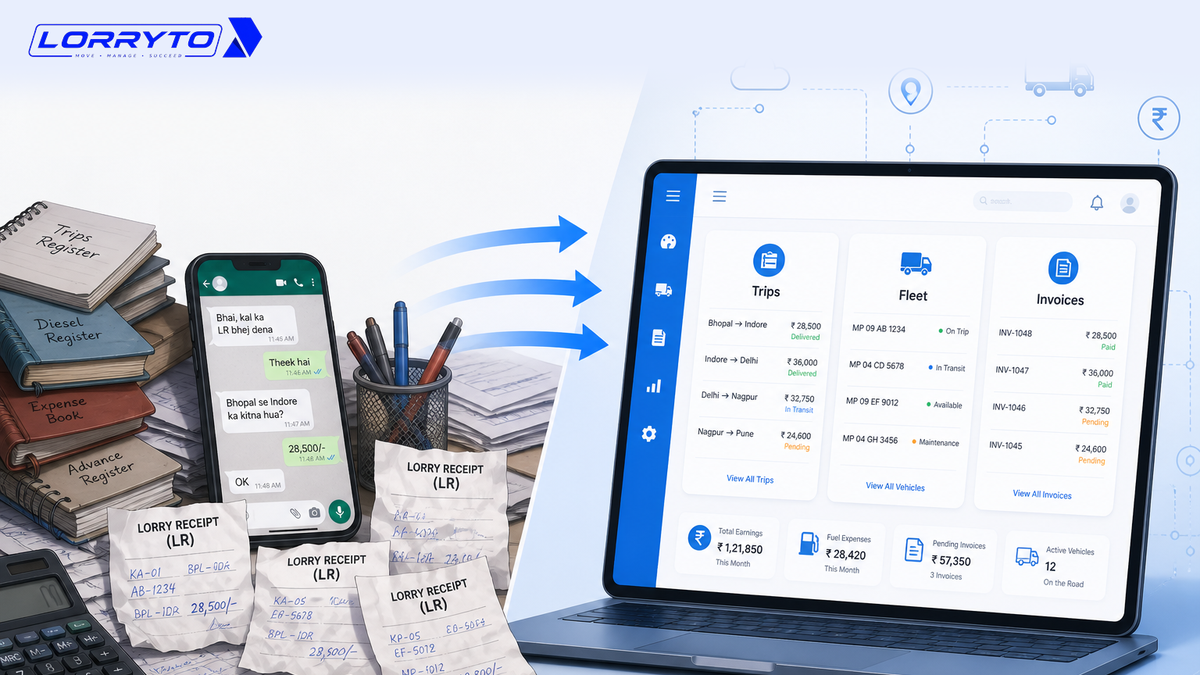
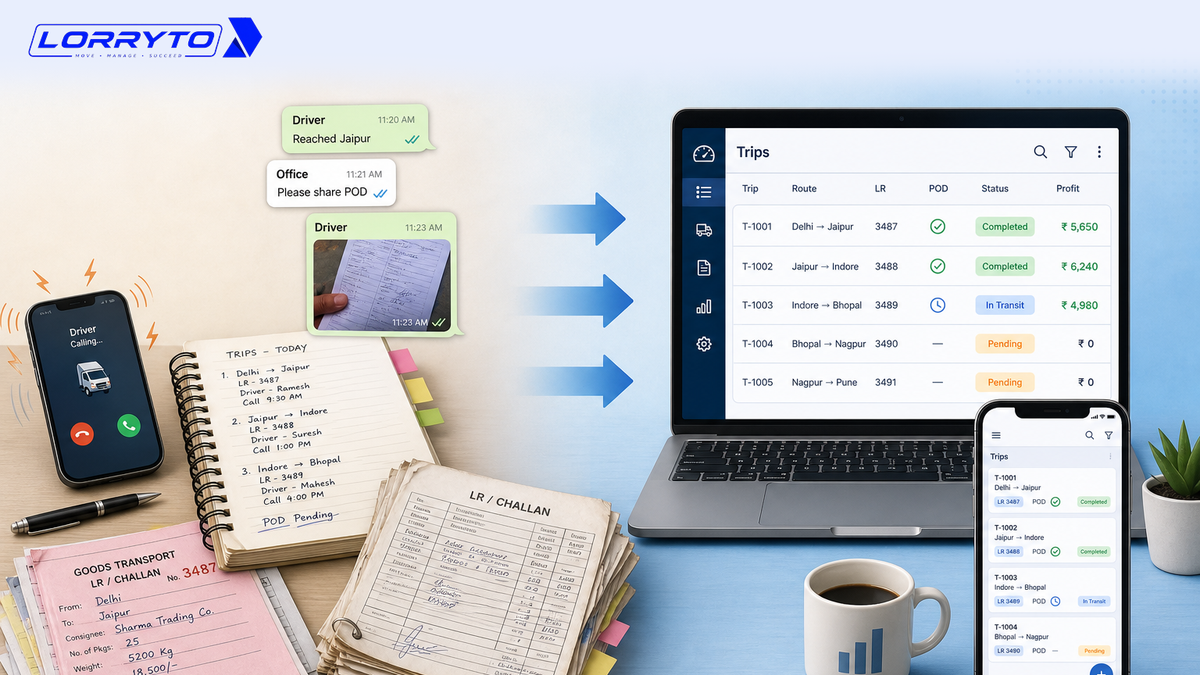
Platforms such as Lorryto can bring operational information such as trips, vehicles, transporters, and day-to-day transport activities into one place.
As trucks become more intelligent, connecting this vehicle-level information with the wider transport operation can become increasingly important.
The real opportunity is not just a smart truck.
It is a smart transport operation around the truck.
Related reading: Agentic AI in transportation and Digitization in India.
From vehicle data to business decisions
Imagine a fleet manager starting the day and opening the transport system.
Instead of going through hundreds of vehicles and trying to identify problems manually, the system could highlight the few areas that actually need attention.
For example:
“Three vehicles need attention today.”
One vehicle has an unusual fuel-consumption pattern.
Another is approaching a maintenance requirement.
A third has a driving-behaviour issue that needs to be reviewed.
The manager does not need to search through every record.
The system has already identified where attention may be required.
This is where intelligent vehicles and transport software can work together.
The truck provides the data.
The transport platform provides the operational context.
AI helps turn that information into a decision.
That combination is much more powerful than any one of these technologies on its own.
The next step: trucks that can learn from their data
As more trucks become connected, another opportunity will emerge.
A truck can generate data from every journey.
Over time, that data can reveal patterns.
Which routes consume more fuel?
Which vehicles perform differently under heavy loads?
Which driving behaviours increase operating costs?
Which conditions are associated with breakdowns?
Which routes regularly cause delays?
Which vehicles are being used less efficiently?
This creates the possibility of continuously improving operations based on actual fleet experience.
The truck does not have to “learn” like a human being.
But the systems around the truck can become better at identifying patterns as more operational data becomes available.
That is where AI becomes increasingly valuable.
What happens when trucks become even more connected?
The intelligent truck we see today is still an early stage.
As technology develops, trucks could increasingly be able to:
- Predict maintenance requirements
- Optimise fuel or energy consumption
- Adapt to changing driving conditions
- Communicate with other vehicles
- Communicate with road infrastructure
- Receive software updates remotely
- Share information directly with fleet systems
- Support increasingly advanced driver-assistance systems
- Work alongside autonomous transportation systems
These developments will not happen at the same speed for every vehicle or every transport company.
But the direction is clear.
The amount of software and intelligence inside commercial vehicles is increasing.
What does this mean for fleet owners?
For a fleet owner, all this technology ultimately comes down to one question:
Does it improve the business?
A truck having more sensors does not automatically make it better.
The technology needs to create a measurable benefit.
Better fuel efficiency can mean:
Lower operating costs.
Better vehicle-health monitoring can mean:
Less unexpected downtime.
Better driver insights can mean:
Safer and more efficient driving.
Better connectivity can mean:
Better fleet visibility.
Better data can mean:
Better operational decisions.
And AI can potentially mean:
Less manual monitoring and faster responses.
That is why the intelligent truck should not be viewed only as an automotive innovation.
It is also a business innovation.
The bigger change in trucking
For decades, improvements in trucks were mainly about physical engineering.
Better engines.
Better transmissions.
Better tyres.
Better aerodynamics.
Better payload capacity.
Those things will continue to matter.
But another layer has now been added:
Intelligence.
The truck is becoming something that can sense, communicate, analyse, and assist.
And this could eventually change what fleet owners expect from their vehicles.
The question is no longer only:
“How much can this truck carry?”
or:
“What mileage does it give?”
It may increasingly become:
“How intelligently can this truck operate?”
That is a very different way of looking at a commercial vehicle.
The future is not just a smarter truck
The most interesting part of this transformation is that the truck is only one piece of the puzzle.
The real value will come from connecting the vehicle with the rest of the transport ecosystem.
A connected truck can provide data.
A transport-management platform can provide business context.
AI can analyse the information and identify what matters.
And eventually, intelligent systems may be able to recommend or automate some of the actions that follow.
For companies such as Lorryto, this creates an interesting direction for the future — not simply adding AI as another feature, but gradually making the entire transport workflow more connected and intelligent.
The technology is still developing, and not every AI capability will be useful for every fleet.
But the direction is becoming difficult to ignore.
The truck is becoming more than a vehicle.
It is becoming a connected, software-driven part of the transport operation.
And the companies that learn how to connect that intelligence with their wider business operations will be better positioned for the next phase of transportation.
The future of trucking may not simply be about building smarter trucks.
It may be about building smarter systems around them.
References and next reads: Agentic AI in transportation · Digitization in India · Trip tracking digitally · Vehicle expenses · Getting started · Mahindra BLAZO i-TRK launch · SAE paper on SDV in Indian CV industry
Ready to run trips without registers?
Create LRs, track payments, and keep documents in one place with Lorryto — free trial available.
Start Free Now